Key points
- China's state venture fund is intended to channel about $137 billion into AI, robotics and advanced manufacturing over 20 years, alongside more than $20 billion in robotics subsidies in a six-month stretch.
- Korea runs the most automated factories on earth, 1,220 robots per 10,000 workers, and still tripled its AI budget to 10.1 trillion won for 2026.
- The US has no national robotics strategy. Its flagship robotics institute runs on roughly $30 million, and a robotics executive order remains unsigned.
Unitree Robotics closed its first day of trading on Shanghai's STAR Market on August 19 up 487%, which put its market value above the $39 billion Figure AI commanded in its September 2025 private round, according to Fortune. Thirteen days earlier, South Korea's finance ministry said it would put 1,000 AI robots a year into its factories. And Washington? A robotics executive order the administration has been drafting since December is still sitting unsigned.
Most of these companies have no US ticker. We keep the codes and prices on our Korean AI stocks directory.
That is the physical AI race in three sentences.
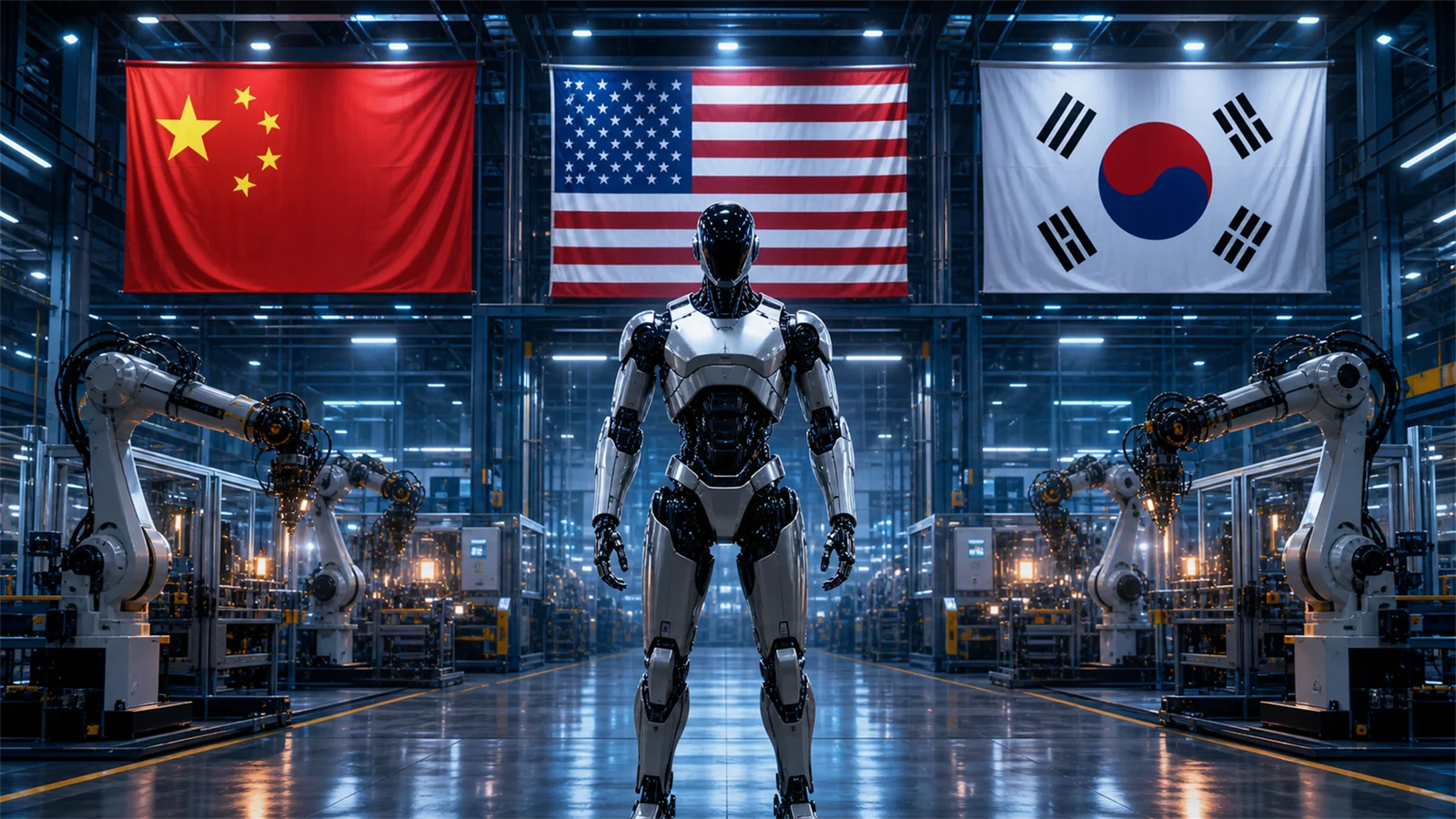
Physical AI is the industry's term for AI that acts on the world through hardware, a factory arm, a warehouse humanoid, a robot dog, rather than a chatbot that only produces text. It is where the money is going next, and the three governments funding it are not spending anything close to the same amounts.
How much is China spending on robots?
Start with the biggest number. China's National Development and Reform Commission announced a state-backed venture capital guidance fund in March 2025 that is intended to channel about 1 trillion yuan, roughly $137 billion, into AI, robotics and advanced manufacturing over 20 years, a commitment the International Federation of Robotics called out as a step change in state support when it was announced. The mandate spans all three sectors, so calling the entire amount robotics spending would overstate it, and the fund, the national subsidies and the city funds below may overlap rather than stack.
That fund is only part of the total. Reuters identified more than $20 billion in Chinese government robotics subsidies during late 2024 and early 2025. The support included grants, loans, tax benefits and state venture capital. Beijing and Guangzhou each introduced a 10 billion yuan robotics fund, worth about $1.4 billion apiece, with Shenzhen and Shanghai following.
Robotics also moved higher in the policy hierarchy this year. It appears in the central outline for the 15th Five-Year Plan, covering 2026 through 2030, as one of eight strategic emerging industries. That may sound like a procedural distinction, but the previous plan addressed robotics in a lower-level ministry document. Placement in the main outline requires coordination among central ministries, provincial governments and state banks. The Ministry of Industry and Information Technology formed a committee for humanoid standardization in December 2025. By March, the committee had released a national standards system covering the industry.
The production figures are just as pronounced. According to the IFR, China installed about 295,000 industrial robots in 2024, accounting for 54% of global installations. Its installed fleet totals roughly 2 million units. No other country operates even one-quarter as many.
Where does Korea stand?
Korea already won one version of this race. The IFR's World Robotics 2025 report, presented on April 8, 2026, recorded 1,220 robots per 10,000 manufacturing workers in Korea. Singapore ranked second with 818, followed by Germany at 449, Japan at 446 and the United States at 307. The worldwide average was 132. Korea has occupied first place for years. It is spending like a country that trails.
The government proposed 10.1 trillion won, about $7.27 billion, for AI in the 2026 budget, up from 3.3 trillion won in 2025, and roughly 6 trillion won of that is earmarked over five years for what the ministry calls AX, meaning AI pushed inside robotics, autos, shipbuilding and manufacturing. Deputy Prime Minister and Finance Minister Koo Yun-cheol called the budget Korea's "final golden opportunity to leap forward as a global leading nation in the era of AI-led transformation."
The physical AI piece landed on August 6, at an Emergency Economic Headquarters meeting in Seoul: 1,000 AI robots deployed per year, humanoids built for 10 industries including chemicals, steel, autos and shipbuilding, and core research money for actuators, sensors and robot hands. Detailed plans for steel and petrochemicals are due in the fourth quarter. The humanoid program itself is older. The trade ministry launched the K-Humanoid Alliance in April 2025 with about 40 members, Rainbow Robotics, Samsung SDI, chip designer DEEPX, KAIST, Seoul National University and POSTECH among them, targeting more than 1 trillion won in investment by 2030.
Koo made the strategic pitch plain at an American Chamber of Commerce lunch in Seoul on August 19. "The US is the world's leader in AI-related software and LLMs," he said. "For that technology to be applied in the real world, it needs to be combined with manufacturing capabilities." Translation: America has the brains, Korea has the factories, and Korea would like to be the body that American AI moves through.
Private money is already building on that bet. Hyundai Motor Group said in February it would put 9 trillion won, about $6.3 billion, into a complex at Saemangeum that includes a 5.8 trillion won AI data center with up to 50,000 GPUs and a 400 billion won robot plant sized for 30,000 units a year, where Boston Dynamics plans to build its Atlas humanoid starting with construction in 2028.
What is the US spending?
Here the numbers get small fast.
There is no federal robotics strategy, and there is no dedicated federal robotics program of any real size. The National Robotics Initiative, run across NSF, USDA, NIH and NASA, invested more than $250 million in over 300 projects across its entire 12-year life before NSF sunset it in May 2022. That is a quarter of a billion dollars, total, over a dozen years, against a Chinese fund built to move $137 billion.
The Information Technology and Innovation Foundation put the sharpest version of this in a June 18, 2026 paper arguing for a national robotics strategy. The ARM Institute, which ITIF calls America's flagship robotics accelerator, "operates on roughly $30 million." The US accounts for 5.4% of global robot exports. It operates less than 10% of the world's industrial robots. Only 8.3% of American manufacturing firms have adopted robots at all.
The biggest federal AI check this year went somewhere else. On July 22 the White House announced more than $5 billion in commitments for the Genesis Mission, an AI-for-science effort created by executive order in November 2025, spanning 278 projects and more than 15 agencies. One of its challenges, "Achieving AI-Driven Autonomous Laboratories," has DOE, HHS, NSF and NIST building robotic labs that run their own experiments. Useful, real, and not factory automation.
What about the robotics executive order? Commerce Secretary Howard Lutnick has been meeting with executives from Apptronik, Boston Dynamics and Tesla, and the reported proposals include tax breaks, federal procurement changes and trade measures aimed at Chinese subsidies. Drafting started in December 2025. As of the end of August 2026, no signature.
What would it cost the US to catch up?
Nobody in the government has said. There is no official number to argue about, which tells you how far along the planning is.
The closest thing to a price tag is ITIF's wish list: a 25% tax credit for robotics adoption, expanded R&D credits, a robotics adoption initiative run through NIST's Manufacturing Extension Partnership, technician training at community colleges, and a National Commission on Robotics to write the strategy that does not exist. A tax credit's cost scales with uptake, so even that list carries no appropriation figure.
Here is the government money actually on the table, by country.
| Country | Program | Amount | Period |
|---|---|---|---|
| China | NDRC state venture capital guidance fund (AI, robotics, advanced manufacturing) | About 1 trillion yuan / $137 billion | 20 years from 2025 |
| China | Robotics subsidies (grants, loans, tax credits, state VC), per Reuters | More than $20 billion | Late 2024 to early 2025 |
| China | Beijing and Guangzhou city robotics funds | 10 billion yuan / about $1.4 billion each | Announced 2023 onward |
| Korea | National AI budget | 10.1 trillion won / $7.27 billion | 2026 alone |
| Korea | AX, AI applied to robotics, autos, shipbuilding, manufacturing | About 6 trillion won / roughly $4.3 billion | Five years from 2026 |
| Korea | K-Humanoid Alliance investment target | More than 1 trillion won / about $685 million | Through 2030 |
| US | Genesis Mission, AI for science, includes autonomous labs | More than $5 billion | Announced July 2026 |
| US | National Robotics Initiative, NSF and partner agencies | More than $250 million | 2011 to 2022, now ended |
| US | ARM Institute, per ITIF | Roughly $30 million | Time basis not stated by ITIF |
One caution on the table. The Chinese and Korean lines are policy commitments, not cash already out the door, and the NDRC fund is a 20-year vehicle rather than a budget line. Still, these are the numbers each government chose to put its name on, and the US column has no strategy-level entry at all. The table mixes a 20-year investment vehicle, annual budgets, multiyear targets, a finished research program and an AI-for-science effort. These figures measure different things and should not be added or compared as annual spending rates. This comparison covers announced national programs. It does not capture private investment, defense procurement or state-level incentives, all of which are particularly important in the United States.
What does this mean for robot stocks?
The market has already voted. Unitree did about 1.7 billion yuan in revenue last year, roughly $240 million, on a little over 5,000 humanoid units shipped, and its Shanghai listing was oversubscribed thousands of times anyway. UBTech, the other listed Chinese humanoid maker, sold 1,079 humanoids in 2025 and lost around $104 million doing it. Neither set of numbers slowed the buying.
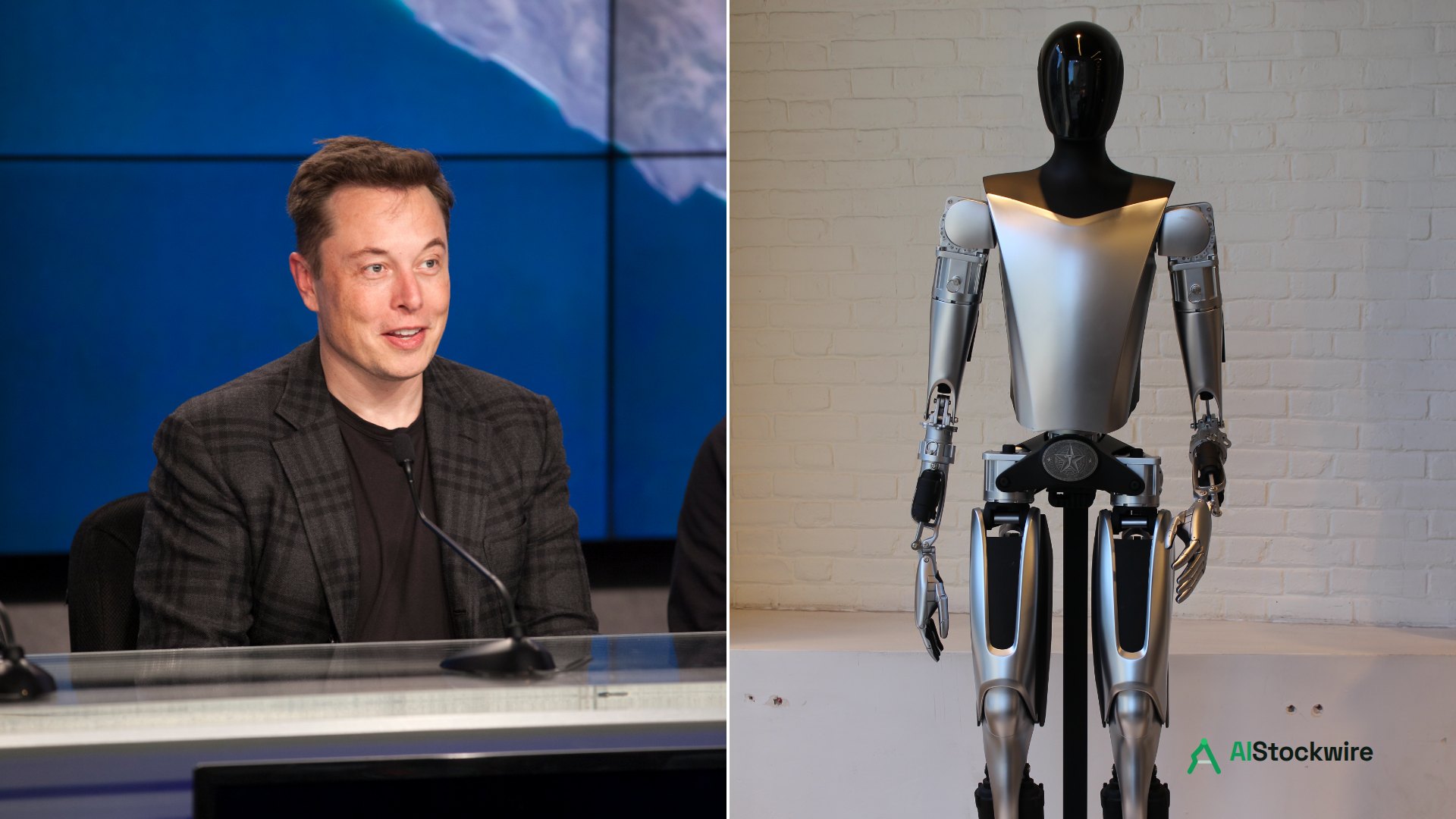
Tesla (TSLA) began Optimus production at its converted Fremont line in August. No unit count has ever been published, and Elon Musk told the second-quarter call that early output would be "quite slow." The most direct US humanoid bet available to retail investors is still Churchill Capital Corp XI (CCXI), the SPAC merging with Agility Robotics, which we broke down after the Unitree listing. The wider field, Mag 7 down to the small caps, is in our physical AI stock rundown.
Korea's steel and petrochemical plans are due in the fourth quarter. The US robotics executive order still has no date.
Companies are reorganizing around physical AI too. Sony's chip unit is bringing about 8,000 workers back to the office so departments can work together in person on new businesses such as physical AI, according to Nikkei.
This is general market commentary, not investment advice. Government spending plans are commitments, not guarantees, and figures converted from yuan and won move with exchange rates. Early-stage robotics companies and pre-merger SPACs carry high risk. Always do your own research and consider speaking with a licensed financial professional before making any investment decision.