Key points
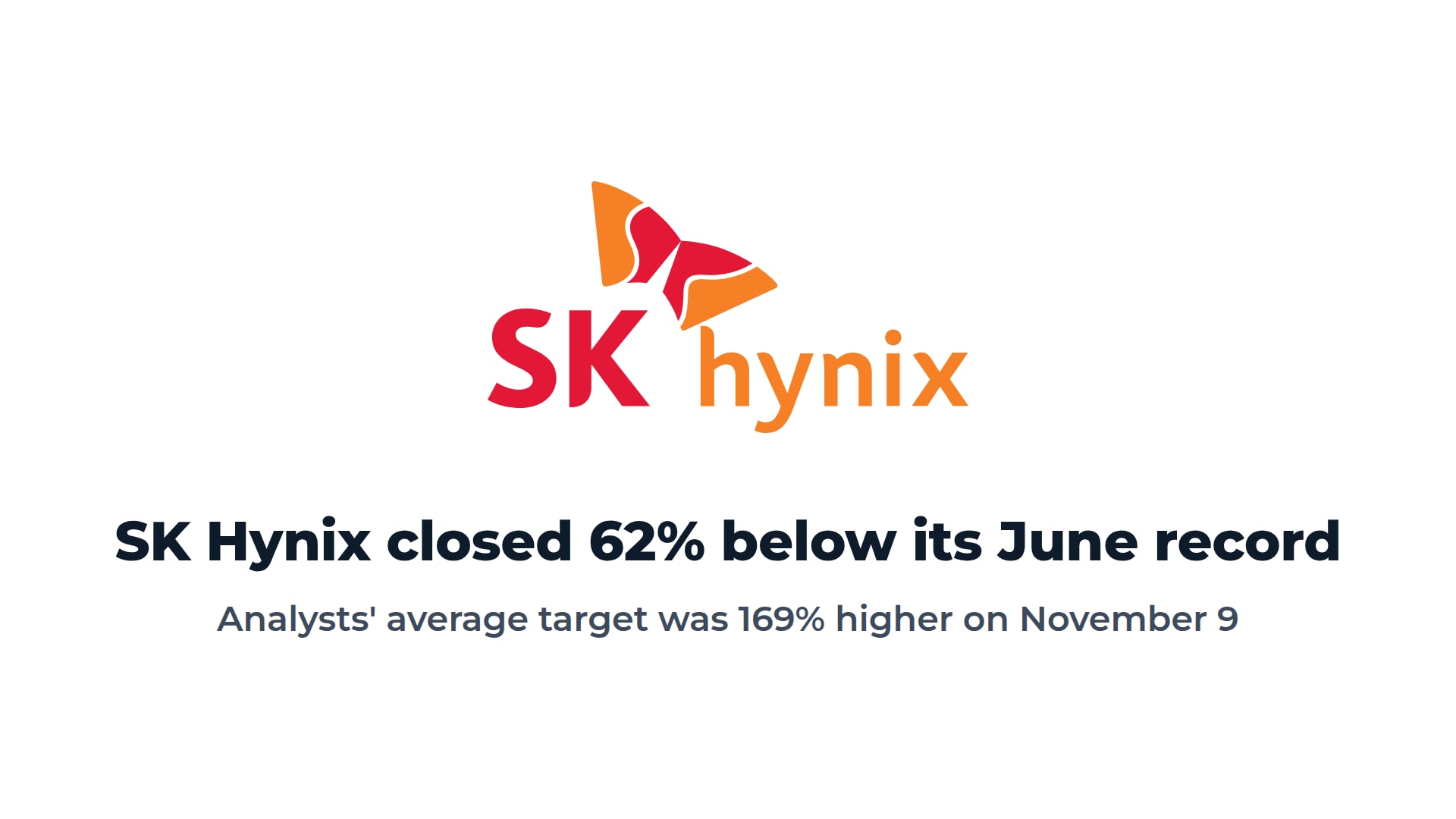
- SK Hynix closed 62% below its June record on November 9
- SK Hynix's average analyst target is 169% above that close
- Individuals' net SK Hynix buys since June 23 were down an estimated $1.56 billion by October 28
On November 10, DS Investment & Securities (DS투자증권) kept its Buy rating and its target price of 2.64 million won ($1,967) on SK Hynix (000660), Hankyung (한국경제) reported. A target price is where an analyst thinks a stock should trade, usually within the next 12 months. DS's target is more than twice SK Hynix's November 9 close of 1,136,000 won ($846).
The shares closed 62% below their record intraday high of 2,987,000 won ($2,226), which they reached on June 25. They lost 22.8% in the five trading days from November 3 to November 9 alone.
DS's target is lower than most. Analysts at 21 brokerages have published targets for SK Hynix in the past three months, according to WISEreport data as of November 9. Their average target is 3,054,286 won ($2,276), which is 169% above the November 9 close, by our calculations. Fifteen of the other 20 brokerages have targets above DS's.
Twenty of the 21 brokerages rate SK Hynix a Buy
Twenty brokerages rate the stock a Buy. BNK Investment & Securities (BNK투자증권) rates it a Hold, and its target of 1.65 million won ($1,230) is the lowest. Even that is 45% above the November 9 close. None of the 21 rates SK Hynix a Sell.
The highest targets are 4 million won ($2,981), from Kyobo Securities (교보증권) and SK Securities (SK증권).
The average target has barely moved through the fall. At the end of June, it was 3.13 million won ($2,330). At the end of October, it was 3.10 million won ($2,308), nearly the same. Over those four months, the stock lost almost half its value.
The latest drop started on November 5. Since then, Korea Investment & Securities (한국투자증권) and Hana Securities (하나증권) have both kept their targets, at 3.2 million won ($2,385) and 3.6 million won ($2,683), in reports dated November 6.
A few brokerages did cut. IBK Investment & Securities (IBK투자증권) lowered its target to 3.2 million won from 4 million won on October 29. On November 4, iM Securities (iM증권) set a target of 2.3 million won ($1,714) in a report that Etoday (이투데이) described as starting coverage. In June, iM had raised its target to 3.5 million won ($2,608), Asia Economy (아시아경제) reported. Etoday didn't say how the new report relates to that June target.
DS expects high profits even if memory prices fall
DS analyst Lee Su-rim kept the firm's forecast for SK Hynix's 2027 operating profit, the profit from its main business, at 443.8 trillion won ($330.7 billion). Lee expects 2029 operating profit of 290.3 trillion won ($216.3 billion) even if memory prices fall in 2028 and 2029. That would be about 65% of the 2027 forecast.
"The fact that it can keep high profits as demand for AI server memory grows, even if chip prices fall, is its medium- to long-term investment appeal," Lee said.
SK Hynix's own numbers have been strong. It reported record third-quarter results on October 28, with quarterly revenue above 100 trillion won ($74.5 billion) for the first time.
A Bank of America analyst says the data hasn't turned
Simon Woo, head of Korea research at Bank of America, made a similar point in an interview with Maeil Business Newspaper (매일경제) on November 9.
"In the past, when chip stocks fell 50% to 60%, there was data behind the downturn, like falling memory prices or a sharp rise in inventory," Woo said. "This time, the stocks crashed while every number, including third-quarter results, was better than ever."
Woo continued, "Since the fall has been excessive, it is time to look at buying at low prices."
iM's Ko Eui-young made a related argument in the firm's November 4 report. "The share price fell 57% from its June 2026 high to its October low, more than the 51% average fall in past downturns, and the market is already assuming a sharp drop in 2028 earnings," Ko wrote.
Yonhap News Agency (연합뉴스) linked the Kospi's fall on November 6 to a 12.25% drop in the Philadelphia Semiconductor Index the day before and to worries about tighter rules for AI data centers in the US. That morning, trading on the Kospi stopped for 20 minutes.
Individuals kept buying and are behind
Individual investors kept buying as the price fell. From June 23 to October 28, they bought 5.4 million more SK Hynix shares than they sold, Etoday reported, using Korea Exchange data. Their average buying price over that time was 1,874,923 won ($1,397) a share.
Etoday estimated a paper loss of 2.09 trillion won ($1.56 billion). A paper loss is a loss on shares that haven't been sold yet. To get it, Etoday applied the average buying price to the 5.4 million net shares and compared that with the October 28 close of 1,487,000 won ($1,108). The calculation doesn't show which shares individual investors actually still hold.
SK Hynix closed 23.6% lower than that on November 9. From there, the shares would need to rise 65% to get back to the individuals' average price, by our calculations.
The buying kept going into November. Individuals bought a net 3.36 trillion won ($2.50 billion) of SK Hynix from October 6 to November 5, according to Koscom CHECK data.
Meanwhile, SK Hynix was up 7.75% at 9:10 a.m. in Seoul on November 10, after the Philadelphia Semiconductor Index rose 6.86% in New York, Chosun Biz (조선비즈) reported. Early in the session, individuals were the only group of investors selling on the main Kospi market, Chosun Biz said.
Won figures are converted at 1,342 won to the dollar, the Naver Finance rate on November 9, 2026. Quotes are translated from Korean.