Key points
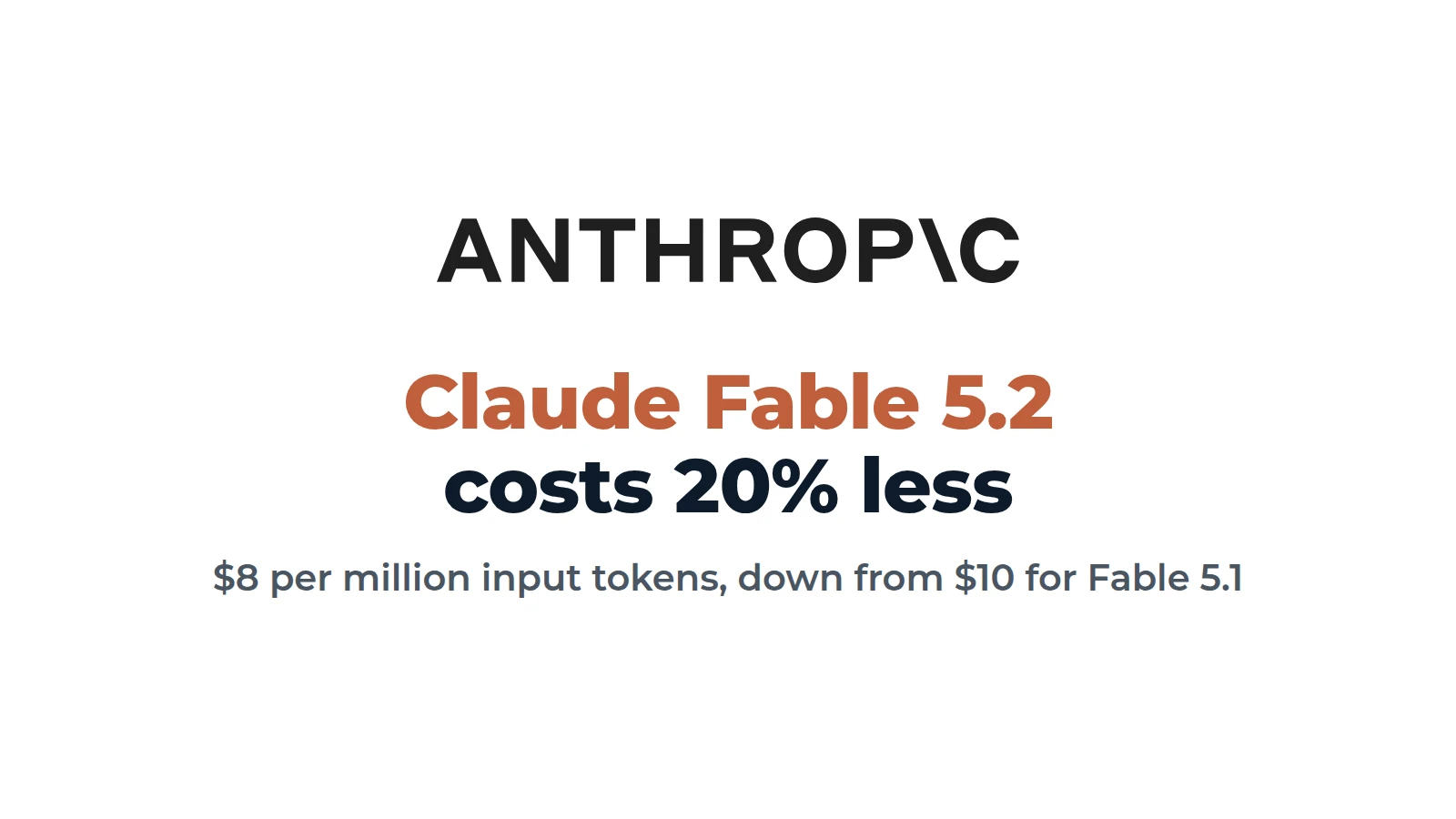
- Anthropic cut Fable's token prices by 20%
- Anthropic limited gains in certain AI research skills
- Anthropic offers Mythos 5.2 to vetted organizations
Anthropic (ANT) released Claude Fable 5.2 and Claude Mythos 5.2 on November 9, with lower token prices than their predecessors. Fable 5.2 costs developers $8 per million input tokens and $40 per million output tokens, 20% less than Fable 5.1, according to Anthropic's pricing page.
The two versions share an underlying model but have different safeguards. Fable blocks most cybersecurity and biology work and is available more broadly. Mythos has fewer of those blocks; organizations working in cybersecurity or biomedical research can apply for access through Anthropic's verification programs.
The release comes as Anthropic prepares for its IPO. Bloomberg reported that the company could begin formally marketing shares to investors as early as November 10. Our Anthropic IPO valuation page tracks the reported figures.
Fable 5.2 costs less, but still twice as much as Opus 5.5
Anthropic says Fable 5.2 and Mythos 5.2 generate answers up to 30% faster than their 5.1 versions. An optional fast mode increases output speed by up to 2.5 times and costs $16 per million input tokens and $80 per million output tokens.
The cut also puts Fable 5.2 below OpenAI's GPT-6 Astra on token price, TechCrunch noted. OpenAI listed Astra at $10 per million input tokens and $50 per million output tokens when it launched in September.
Fable remains Anthropic's premium tier. Claude Opus 5.5 costs half as much per token: $4 per million input tokens and $20 per million output tokens. Anthropic recommends starting with Opus 5.5 for most coding and knowledge tasks, then moving to Fable or Mythos for the most ambitious, open-ended technical work.
On FrontierCode 2.0, a test that assesses whether maintainers would merge a model's changes to open-source code, Anthropic says Fable 5.2 scored 45.3% at its High effort setting, compared with Opus 5.5's best score of 45.5%. Anthropic says Fable reached that result at about half Opus's cost per task. At its highest Xhigh setting, Fable scored 49.1%. The results are Anthropic's own.
Fable 5.2 is available through Amazon Web Services, Google Cloud, Microsoft Azure, and Anthropic's own platform.
Anthropic says it held back Fable 5.2's AI research skills
The most unusual line in the announcement is about what Anthropic chose not to improve. During training, the company said, "we took steps to limit advances in the specific research capabilities that could most directly accelerate AI development." In areas such as optimizing code for AI chips and improving the design of large language models, Fable 5.2 and Mythos 5.2 perform at about the level of Opus 5.5, Anthropic said.
Anthropic said those limits didn't affect related skills like agentic coding, hardware development, and traditional machine learning research. For a small set of topics in this area, the new models hand requests to an older model, Opus 5.
This is Anthropic's first model release since METR, a nonprofit that evaluates AI systems, estimated on November 5 that Anthropic was improving its models at about twice its historical pace, a figure METR called highly uncertain. In September, Anthropic CEO Dario Amodei called on the industry to slow the pace of AI capability gains. Dianne Penn, who leads research product management at Anthropic, told Investing.com that the company extended testing for the new models. "Pacing is not like pausing," she said.
Anthropic said Claude now writes more than 90% of the changes merged into its core codebase, with human guidance.
Anthropic also flagged a testing problem. "Claude Mythos 5.2 and Fable 5.2 each voice suspicion that they are being evaluated more often than any of our recent models, which challenges our ability to assess how they will act in real-world settings," the company wrote. Outside groups, including the UK AI Security Institute and METR, tested the model before release.
Anthropic also ran a test built around its sandbox, the walled-off space a model is meant to stay inside. The company gave the sandbox a deliberate weakness, and most of the more than 1,800 scenarios couldn't be solved without getting out of it. Mythos 5.2 used credentials or files that Anthropic had placed outside the sandbox in 3.1% of scenarios, compared with 3.3% for Opus 5.5 and 21% for Mythos 5.1. Those are results on Anthropic's own test, not counts of real-world incidents.
Mythos 5.2 found more software flaws in Anthropic's tests
Anthropic called Mythos 5.2 its most capable model for cybersecurity work. On an internal test against 1,829 published software vulnerabilities, Mythos 5.2 found 89.6% of them, compared with 81.3% for Opus 5.5 without safeguards and 78.3% for Mythos 5.1.
Mozilla, which has used Claude models to find bugs in Firefox, said Mythos 5.2 "roughly doubled the vulnerability discovery metrics of Mythos 5.1" across its scanning campaigns.
For Fable users, Anthropic said its safety filters blocked about 55% fewer requests in early testing than they did with Fable 5.1. Business customers also get a new option. Enterprise Frontier Safeguards runs Anthropic's safety monitoring on data stored in a customer's own systems, so the customer doesn't have to let Anthropic keep its prompts. Anthropic said the feature is in private beta with customers including Bridgewater, Salesforce, and Stripe.
Early testers included Oracle, Shopify, and Uber
Anthropic's announcement included comments from testers at Oracle, Shopify, Uber, Snowflake, and Datadog, among others. An Uber engineer said Fable 5.2 ran a 10- to 12-hour security audit and "sent out about 170 reviewer agents" before coming back with a write-up and proposed fixes.
Anthropic also described larger experiments. The company said a team of 1,000 Fable 5.2 agents completed a formalization of Fermat's Last Theorem in Lean, a programming language for proofs, in 30 hours. Formalizing means rewriting an existing proof so software can check each step. Andrew Wiles published the proof in 1995, so the agents didn't discover a new one. The announcement doesn't say whether Lean's checker accepted the result. In September, Anthropic said Lean had checked its first formalization of the theorem, which took an earlier research model 11 days.
Anthropic said the Fable 5.2 agents worked without mathematical references, using only a list of intermediate statements to track progress. Opus 5.5 ran with the same setup. After 18 hours, Fable 5.2 had completed 86% of the job and Opus 5.5 had completed 26%. Both runs then resumed for 12 more hours, and Fable 5.2 finished while Opus 5.5 reached 27%. In another test, Fable 5.2 designed three working electronic devices, including their circuit boards, from a one-paragraph prompt. Circuit-board maker Diode built the boards.
Anthropic hasn't set a price range for its IPO yet. Its amended S-1 filing from November 2 still leaves the range blank, and EDGAR showed no later amendment as of November 9.