Key points
- Tempus AI gets a new five-year AstraZeneca commitment
- How much AstraZeneca has to spend each year
- What happens if AstraZeneca spends less
- How the deal compares with Tempus's data sales
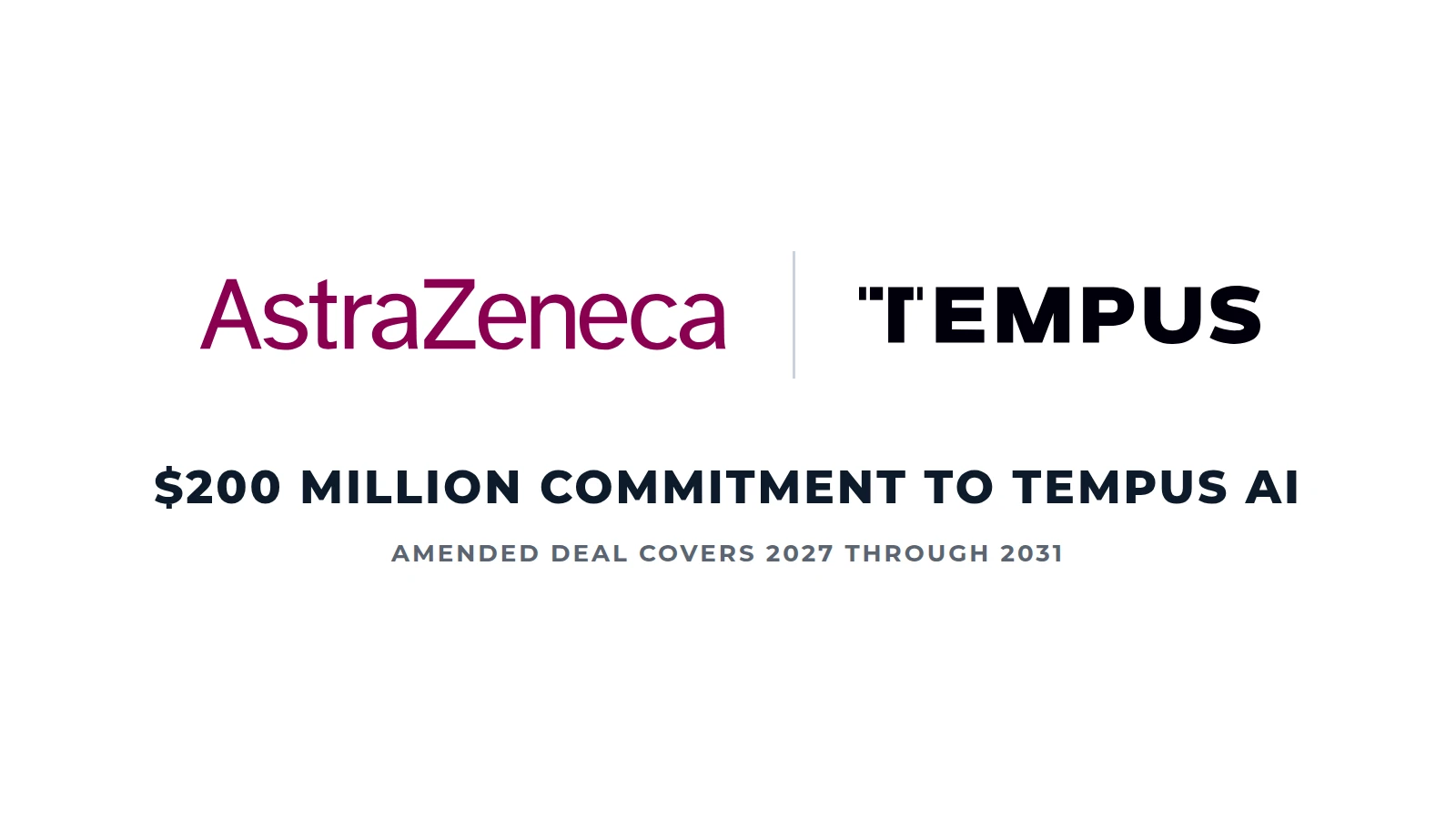
AstraZeneca (AZN) has committed $200 million in fees to Tempus AI (TEM) for patient data and AI tools used in cancer research under an amended agreement covering 2027 through 2031.
The deal sets a target of $40 million a year, with a $32 million annual minimum. It also includes provisions to extend the agreement and to waive or reduce shortfalls. The amendment pushes the agreement's end date from 2028 to 2031.
Tempus shares were at $63.25 at 12:17 p.m. ET on Nov. 18, down 0.3% from the Nov. 17 close of $63.43.
What does AstraZeneca have to spend?
The amendment, signed Nov. 16 and effective Jan. 1, 2027, covers five years. AstraZeneca's $200 million commitment works out to a $40 million annual target, though the minimum for each year is $32 million.
The fees pay for patient data with names and other identifying details removed, access to Tempus's Lens software, and a dedicated Tempus team for AstraZeneca's work. Spending under other agreements between the companies and their affiliates counts toward the total too. A fee counts once it has been paid or is owed for work Tempus agreed to deliver that year.
What happens if AstraZeneca spends less?
The amendment spells this out with an example set in 2027. If it looks on Dec. 1 like AstraZeneca will only reach $31 million for the year, the two companies sign an order by Dec. 31 for $1 million of extra patient data to make up the gap.
The same kind of fix applies to the five-year total. If AstraZeneca's fees come in under $200 million by the end of 2031, the agreement runs one more year, through 2032. If the shortfall still looks likely that December, AstraZeneca buys more data to cover it.
AstraZeneca can still end the agreement at any time. If the drugmaker does, AstraZeneca owes Tempus whatever is left of the $200 million, plus anything unpaid from the $220 million AstraZeneca committed for the first term, the amendment says. It also lists six situations where a shortfall would be waived or reduced. Tempus blacked out all six, along with the prices, in the public copy, saying the details aren't material and are the kind Tempus treats as private.
How does this compare with the first term?
The two companies signed their original agreement on Nov. 17, 2021. The amendment calls the stretch from then through Dec. 31, 2026, the first term, and AstraZeneca's commitment for that period was $220 million. The new term is a little shorter, five calendar years, with $200 million attached.
The new deal is the fifth amendment, and it replaces the terms of the fourth, signed March 14, 2025, and adds a new section on a 2025 Justice Department rule that limits how Americans' sensitive personal data can be shared with countries the rule names, a list that includes China. Both companies state that neither is a "Covered Person" or acting for a "Country of Concern," the rule's own terms, and they agree the data license may count as data brokerage under it.
How big is $40 million a year for Tempus?
Tempus has two businesses. Diagnostics is the genetic testing Tempus runs for patients and doctors. Data and applications sells data and software to drug companies like AstraZeneca.
Data and applications brought in $108.1 million in the third quarter, up 33% from $81.3 million a year earlier, the company's quarterly report shows. Total revenue was $411.5 million. Split evenly across the year, AstraZeneca's $40 million target would be $10 million a quarter, about 9% of that third-quarter data revenue. That even split is only a way to show scale. Actual quarterly amounts depend on the $32 million yearly floors, spending under the companies' other agreements, and when Tempus delivers the work.
Where does Pathos fit in?
There's a second $200 million figure tied to the same AstraZeneca agreement, and it's easy to mix up with this one. Pathos AI is building a large cancer AI model for AstraZeneca under that agreement. Pathos is paying Tempus $200 million in data license fees over three years under a separate April 2025 deal with Tempus, including $50 million paid up front, the quarterly report says. Pathos can pay up to half of those fees in Pathos preferred stock, and Pathos paid $8.8 million that way in June and another $8.8 million in August.
Tempus has paid Pathos $35 million under that deal, $25 million in July 2025 and $10 million in October 2026. Tempus also holds a warrant for about 15% of Pathos. Pathos raised a $237 million round led by Bristol Myers Squibb in October, with Tempus supplying neurology data.
We covered Tempus's two businesses and the stock in more detail in our Tempus deep dive.