Key points
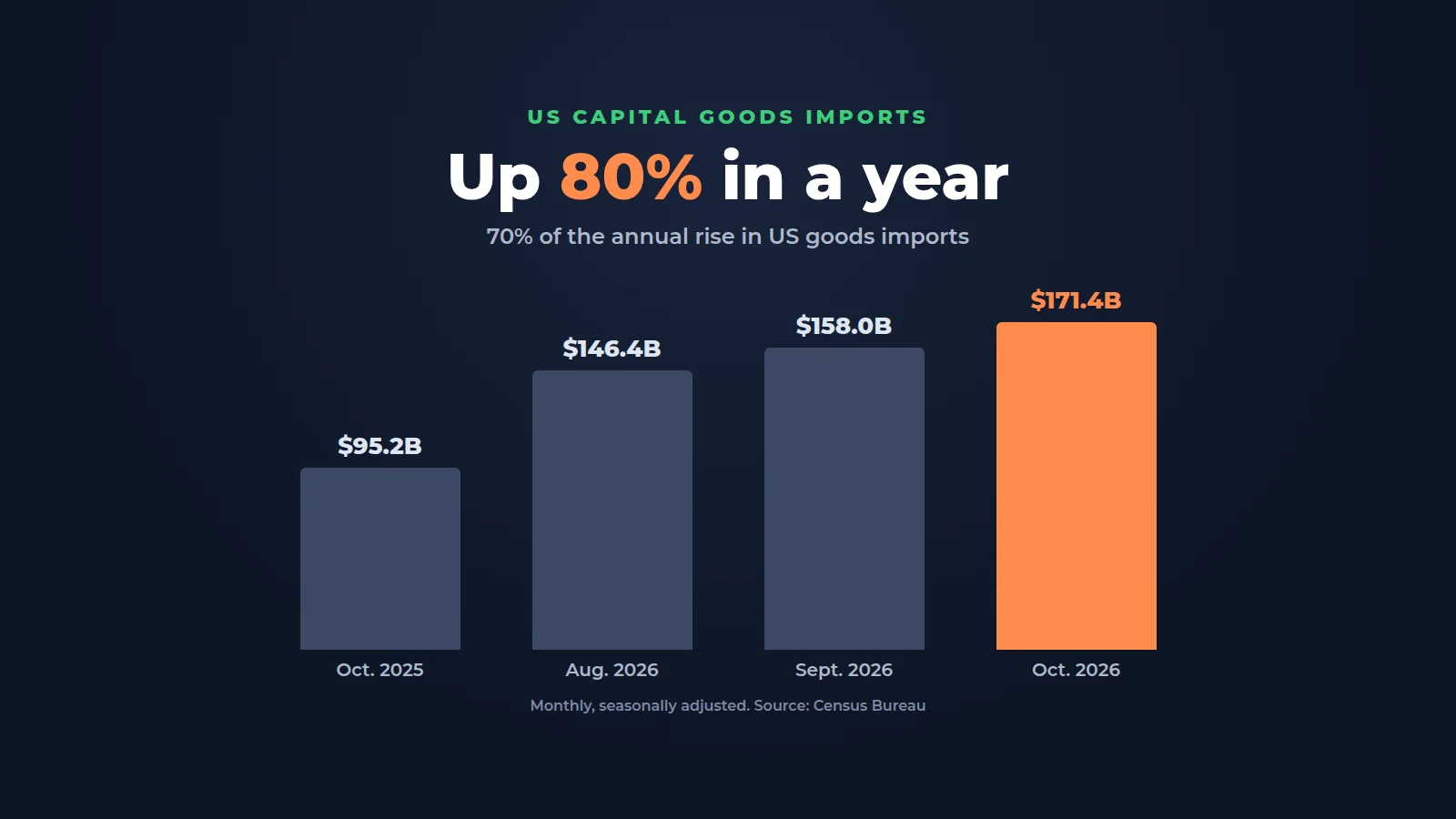
- US capital goods imports reached $171.4 billion in October, up 80% from a year earlier
- Capital goods accounted for 70% of the annual rise in goods imports
- Goldman Sachs says the import surge is reducing AI's contribution to GDP
The US imported $171.4 billion of capital goods in October, up 80% from a year earlier, the Census Bureau said in its advance trade report on Nov. 27. The category includes equipment businesses use to produce goods and services, such as computers, semiconductors, telecommunications gear, and industrial machinery.
Total goods imports rose 6.1% from September to a record $365.3 billion. The goods trade deficit widened 10.7% to $149.5 billion, above the $133 billion economists expected, Reuters reported.
Capital goods drove most of the annual increase
Capital goods imports rose $76.2 billion from October 2025, accounting for 70% of the $108.7 billion increase in total goods imports. They made up 47% of goods imports in October, up from 37% a year earlier.
| Seasonally adjusted, billions | Oct. 2025 | Oct. 2026 | Change |
|---|---|---|---|
| Total goods imports | $256.6 | $365.3 | +42.4% |
| Capital goods imports | $95.2 | $171.4 | +80.0% |
| Capital goods exports | $58.7 | $75.8 | +29.2% |
| Capital goods trade gap | $36.6 | $95.6 | +$59.1 |
| Total goods trade gap | $61.4 | $149.5 | +$88.0 |
Source: Census Bureau advance report, Nov. 27, 2026, Table 1. The capital goods trade gap is AIStockWire's calculation of imports minus exports.
The capital goods gap widened by $59.1 billion over the year, about two-thirds of the $88 billion widening in the overall goods deficit.
The increase has continued in recent months. Capital goods imports rose from $146.4 billion in August to $158.0 billion in September and $171.4 billion in October.
Economists tie the surge to AI spending
The advance report doesn't break capital goods into smaller categories, so it doesn't show how much of the increase came from AI servers and chips. The Census Bureau's full trade report will have that detail.
Goldman Sachs economists wrote that the import surge is "one reason why AI is adding less to GDP" than corporate spending figures suggest, according to the same report. In the calculation of gross domestic product, imports are subtracted to remove foreign production already counted in spending. That means spending on imported AI equipment adds less to US output than the investment figure alone suggests. Trade cut 3.21 percentage points from third-quarter growth, which came in at a 4.3% annualized rate, and Goldman lowered its fourth-quarter estimate by 0.2 percentage point to 2.2%.
Dell Technologies (DELL) said on Nov. 24 that its AI backlog reached $132 billion, and its third-quarter revenue more than doubled from a year earlier.
Imports have kept rising despite President Donald Trump's tariffs. On Nov. 25, the US proposed new tariffs of up to 35% on 14 economies, including Japan, South Korea, and Taiwan. None has taken effect.
The next advance report, for November, is scheduled for Dec. 28.