Key points
- Nvidia told Dell and Supermicro to stop shipping its servers to four Southeast Asian countries
- Nvidia's halt follows a US licensing rule for advanced chips sent to the region
- Nvidia booked $104 billion through its Singapore unit in 2025, the FT reported
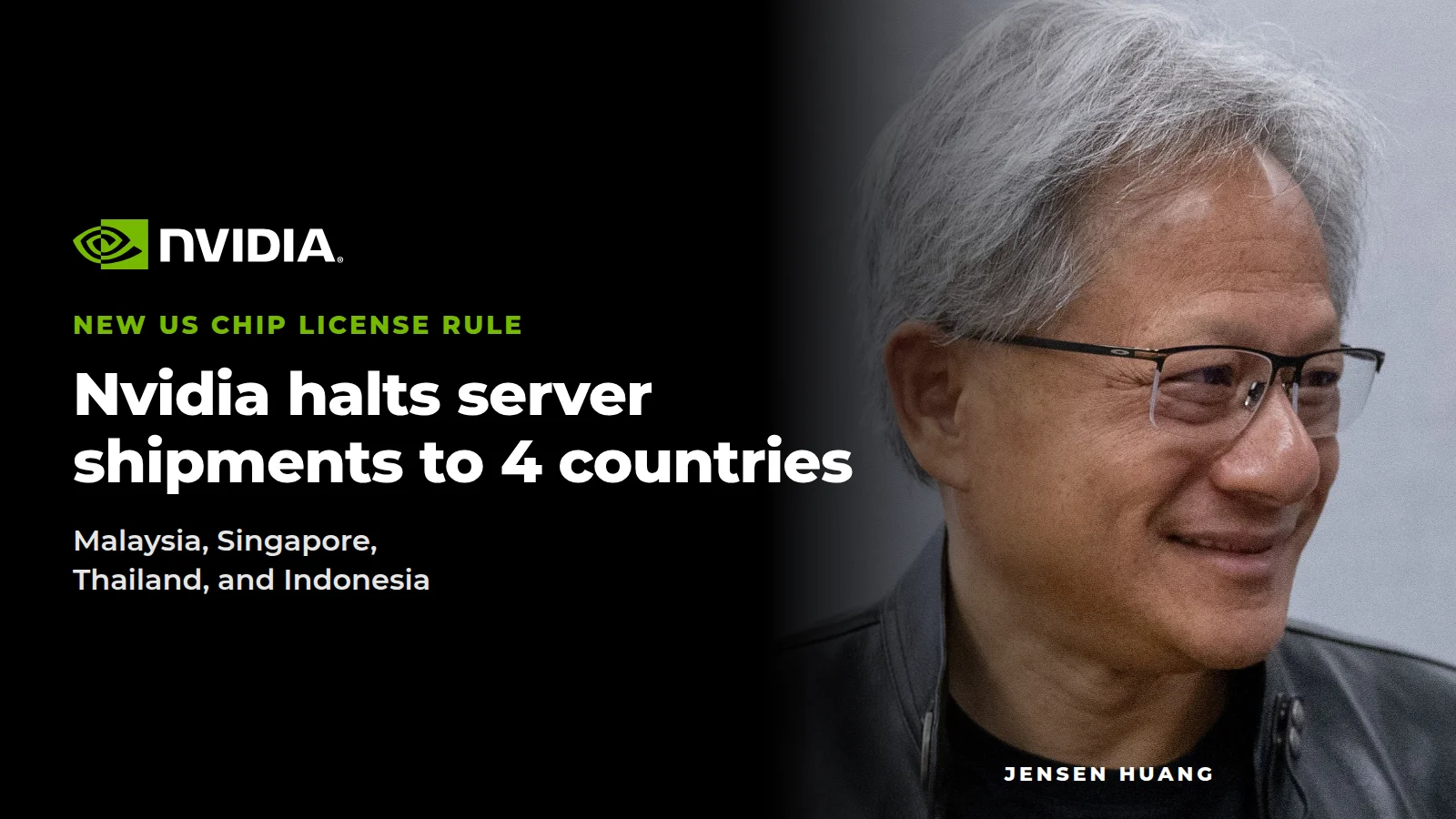
Nvidia (NVDA) has told manufacturing partners to stop shipping servers that contain its chips to Malaysia, Singapore, Thailand, and Indonesia, the Financial Times reported on Nov. 26. Partners including Dell Technologies (DELL) and Super Micro Computer (SMCI), which build Nvidia's chips into servers, have told buyers in those countries that Nvidia won't allow their orders to ship, according to the report.
It's unclear whether the halt is temporary while Nvidia and its partners work out how to comply with new US export controls, the FT reported. Nvidia declined to comment. Dell and Supermicro didn't respond to the newspaper's requests for comment.
A US license rule for the four countries took effect Nov. 19
The Commerce Department's Bureau of Industry and Security (BIS) released the rule on Nov. 16. It was published in the Federal Register on Nov. 19 and took effect the same day. It requires a license to export or reexport advanced AI chips to Indonesia, Malaysia, Singapore, Thailand, and Brazil, or to transfer them within those countries. BIS calls them countries that "present a higher-than-normal risk of diversion," meaning chips sent there could be passed on to buyers the US has restricted.
The same rule reaches data centers anywhere in the world that give companies based in China, Macau, and other countries of concern large amounts of computing power. Data centers that were already doing that before the rule have 90 days, until Feb. 17, 2027, to get a license "or face future export restrictions," the rule says. Our explainer on the remote-access rule covers how much computing power triggers it.
A cloud provider executive told the FT that the rule came with "no guidance on execution."
The five-country license rule has a US-company exception
The license requirement for the five countries doesn't apply to chips going to companies headquartered in the US, or whose ultimate parent company is, as long as reporting requirements are met. Other US export restrictions may still apply. The FT report doesn't say whether Nvidia's halt covers orders from those companies.
Brazil is the fifth country named in the rule. It isn't among the four in the reported halt.
One project caught up in the rule is Singapore-based Aolani Cloud, which planned to lease computing power to ByteDance, the Chinese owner of TikTok, according to the FT. Some bankers who had agreed to finance the project have stopped issuing about $500 million of credit, and ByteDance may drop the deal, the FT reported. Bloomberg had reported on Nov. 17 that lenders paused a $480 million loan to Aolani for Nvidia chips at a data center in Malaysia.
Nvidia's Singapore unit booked $104 billion in 2025
Southeast Asia is a big market for Nvidia. The company booked $104 billion of revenue through its Singapore subsidiary in 2025, up 72% from a year earlier, according to company accounts cited by the FT. Nvidia also records some of its Taiwan and China revenue through that unit, the FT reported, so the figure isn't the same as sales shipped to Singapore.
The region is also at the center of the scandal that led Jensen Huang to resign as Nvidia's CEO on Nov. 11. Huang had a relationship with Alice Huang, whom US officials suspected of gathering information for China. She is a former executive at Megaspeed, a Singapore-based Nvidia customer. Nvidia's board reinstated Huang on Nov. 22, and Commerce added Megaspeed and six other companies to the US entity list the next day.
Nvidia shares fell 3.9% before the holiday
Nvidia shares closed at $149.30 on Nov. 25, down 3.9% on the day, before the FT report. US stock markets are closed for Thanksgiving on Nov. 26 and reopen on Nov. 27 for a shortened session that ends at 1 p.m. ET.