Key points
- China's first AI-made theatrical film cost more than $1.5 million
- What Bona's chief executive says a live-action version would cost
- How Bona Film shares traded after the opening weekend
- Why AI microdramas may work better than a feature film
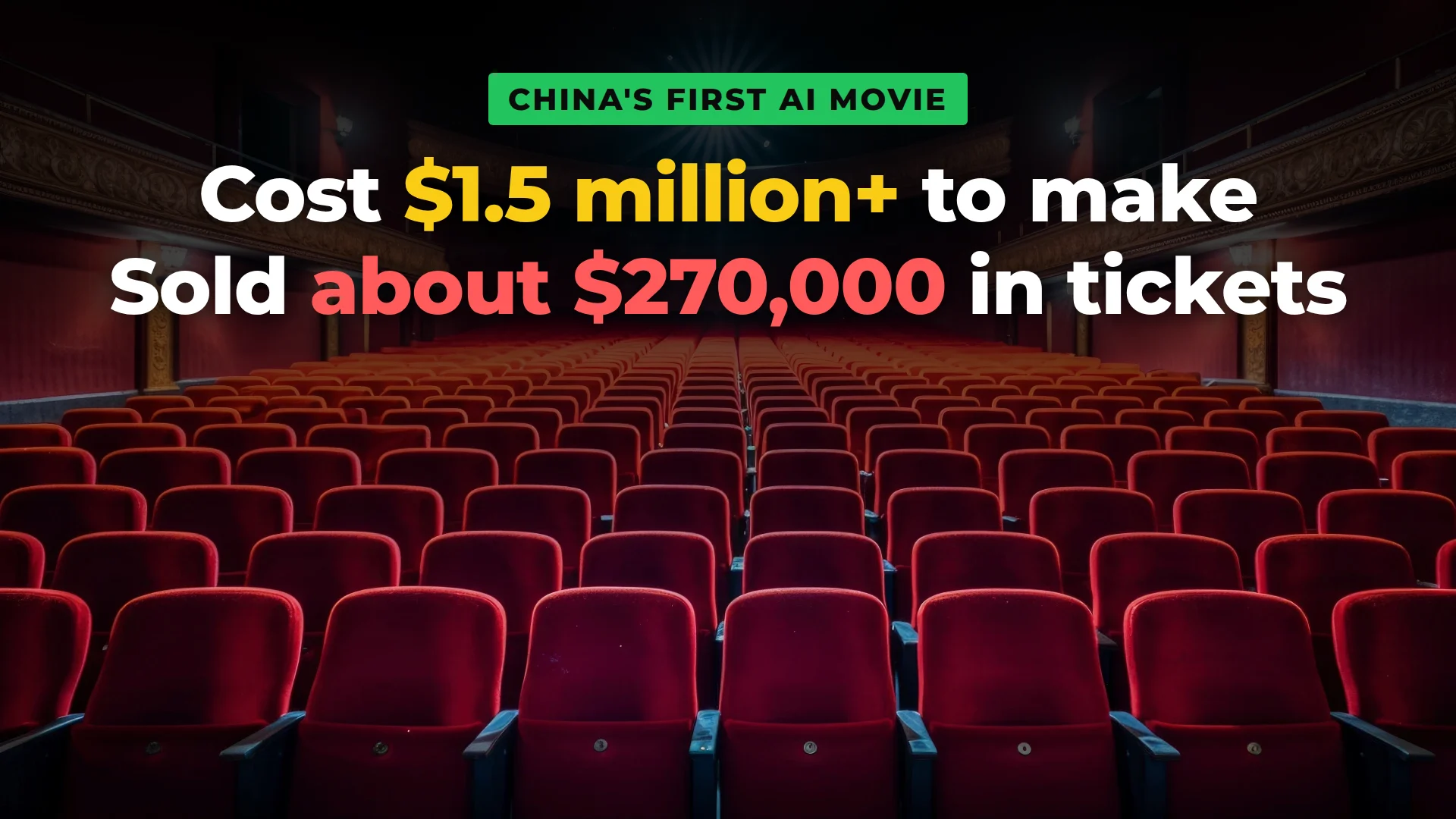
China's first AI-made film to reach theaters took nearly 100 people more than two years to produce and cost over 10 million yuan ($1.5 million), according to its studio. Bona Film Group (001330) released Sanxingdui: Future Past on Oct. 23, and the film had sold about 1.8 million yuan ($270,000) in tickets after three weeks, TechSpot reported, citing Beacon Pro box office data.
The Economist called it the first-ever AI-generated movie on Nov. 26. The filmmakers "did not just ask a chatbot to 'make me a movie'," the magazine wrote. A crew of screenwriters, cinematographers, and others spent more than two years using AI to make the 100-minute science fiction film, according to the Economist.
Other AI-made features have had limited releases, including India's Love You in May 2025, according to The Hollywood Reporter. With more than 10,000 opening-day screenings, Sanxingdui was the first to get a wide release with reported box office numbers in a major market, the trade paper said.
What Bona's budget paid for
AI replaced the lighting and camera crews, but the production still needed screenwriters, directors, art staff, and editors, Caijing magazine reported on Nov. 4. The team generated more than 1.2 million base images and went through more than 100 versions of the full film.
The AI models changed during production, too. In April, Caixin reported that the film was made with video tools from ByteDance. Caijing named the Vidu model from Shengshu Technology as the film's main technical support. The team switched its main model twice in two years, and about half the shots in trailers released in March and May were replaced in the final cut, Huxiu reported.
Jiang Defu, Bona Film Group's chief executive and the film's producer, told Caijing that a new model would sometimes come out after the team had finished a batch of footage. The old footage "either couldn't be used or was too far from what we wanted," he said, so the team made it again.
China's National Film Administration approved the film's content on April 10, according to Caijing. Regulators classified it as an animated feature because they didn't have a separate category for AI-generated films, Caixin reported.
An AI movie cost about $15,000 per minute
By our calculations, more than 10 million yuan spread over 100 minutes comes to more than 100,000 yuan ($15,000) per minute of finished film. Jiang told Caijing that making the film the traditional way would have cost at least 300 million yuan ($45 million). That works out to 3 million yuan ($449,000) per minute.
The 300 million yuan figure is Bona's own estimate, and Caijing's report doesn't break down either number.
Few people bought tickets
The film took in an estimated $180,000 through Oct. 26, its first Monday, according to ticketing platform Maoyan, Fortune reported. By the evening of Nov. 3, it had earned 1.698 million yuan ($254,000) from about 59,000 moviegoers, according to Beacon Pro data cited by Huxiu.
Those figures are ticket sales, not Bona's proceeds. Theaters and distributors take a share of the box office, so the studio's cut is smaller. Caijing's report also doesn't say whether the 10 million yuan cost includes marketing and release spending, so the film's exact loss isn't known.
Some viewers praised big scenes like a sacred bird's arrival. Others pointed to stiff facial expressions and a jumpy plot, Huxiu reported. One viewer said it was "like turning an AI short drama of dozens of episodes into a feature film."
Jiang spoke about the release with the Chinese film outlet Yuli, AFP reported. "We are the first to try it, the first to get a theatrical release permit and the first to be tested by the audience. I think that is not easy at all," he said.
Stanley Rosen, a professor at the University of Southern California, told Fortune that "the financial loss of Sanxingdui: Future Past will compel others contemplating using AI for feature films to tread more carefully."
Bona Film shares gave back their AI run-up
Bona's shares hit Shenzhen's 10% daily limit up on Sept. 28, Oct. 9, and Oct. 12 after the company set the release date, and its market value rose from about 8.7 billion yuan ($1.3 billion) to 10.5 billion yuan ($1.57 billion), Huxiu reported. Bona twice warned investors that the film's box office was uncertain.
On Oct. 26, the first trading day after the opening weekend, the stock fell by the daily limit to close at 5.54 yuan, according to Caijing. It closed at 5.08 yuan on Nov. 26, according to Eastmoney data. That's 34% below its Oct. 12 close of 7.67 yuan and 12% below its Sept. 24 close of 5.78 yuan, the last close before the release date was announced.
Bona's revenue for the first nine months of 2026 fell 21.07% to 767 million yuan ($115 million), and it posted a net loss of 246 million yuan ($37 million), the company reported on Oct. 30. Its AI film and TV business brought in 1.93 million yuan ($289,000) in the first half, or 0.42% of total revenue, according to Huxiu.
Bona has started production on its next AI film, which IndieWire translated as Unplanned Operation in the Cold Moon. Jiang expects a standing team of about 50 people and a production schedule of a few months, Huxiu reported.
An AI-made US feature film opens Dec. 4
Gods Don't Give Gifts, from the YouTuber Gossip Goblin and distributed by Fable, is set for a limited US release on Dec. 4. The Hollywood Reporter called it the first AI-generated feature film in the United States. It's an R-rated anthology of four science fiction stories, according to the trade paper.
Separately, Disney (DIS) hired Adobe (ADBE) on Nov. 9 to build private AI models trained on its own characters.
AI already makes most of China's microdramas
Sanxingdui began as an AI short drama that Bona posted on Douyin in July 2024. It passed 200 million views, according to Huxiu.
China put 430,000 microdramas online in the first eight months of 2026, 13 times as many as in all of 2025, and more than 90% of them were AI dramas, Wang Xiaoliang, an official at China's National Radio and Television Administration, said on Sept. 17, according to Caijing.
A 100-minute film is harder for the same tools. Video models mostly generate clips of a dozen to a few dozen seconds at a time, so a feature has to be built from a huge number of short clips that are then stitched together, Caijing reported.
Qin Lin, founder of the AI video company Xuanjia Technology, told Caijing that a short drama "may only need a hook in this episode and a story that makes sense." A feature film makes completely different demands on narrative logic, foreshadowing, and emotional pacing, Qin said.
Bona founder Yu Dong said before the release that images viewers accept on a small screen can turn into a mosaic on a big screen, according to Huxiu.
Michael Berry, a University of California professor, said Chinese audiences may see AI content as cheap entertainment to watch on their phones, not something to pay for in a theater, TechSpot reported.
Short AI video has an audience, and features are harder
I think that's where the technology is right now. Short, serialized content already has an audience, and more than 90% of the microdramas China put online in the first eight months of 2026 were AI dramas. This film shows how much harder it can be to get people to pay for a 100-minute AI feature in a theater. That tells me more than either the hype about AI replacing Hollywood or the gloating over one flop.
Quotes from Caijing and Huxiu are translated from Chinese. Yuan figures not given in dollars by the source are converted at 6.6832 yuan to the dollar, the ExchangeRate-API rate on November 26, 2026.