Key points
- SoftBank's five-year credit default swap spread reached a four-year high
- What SoftBank's rising cost of default protection means
- SoftBank shares rose 7.3% in Tokyo as the spread widened
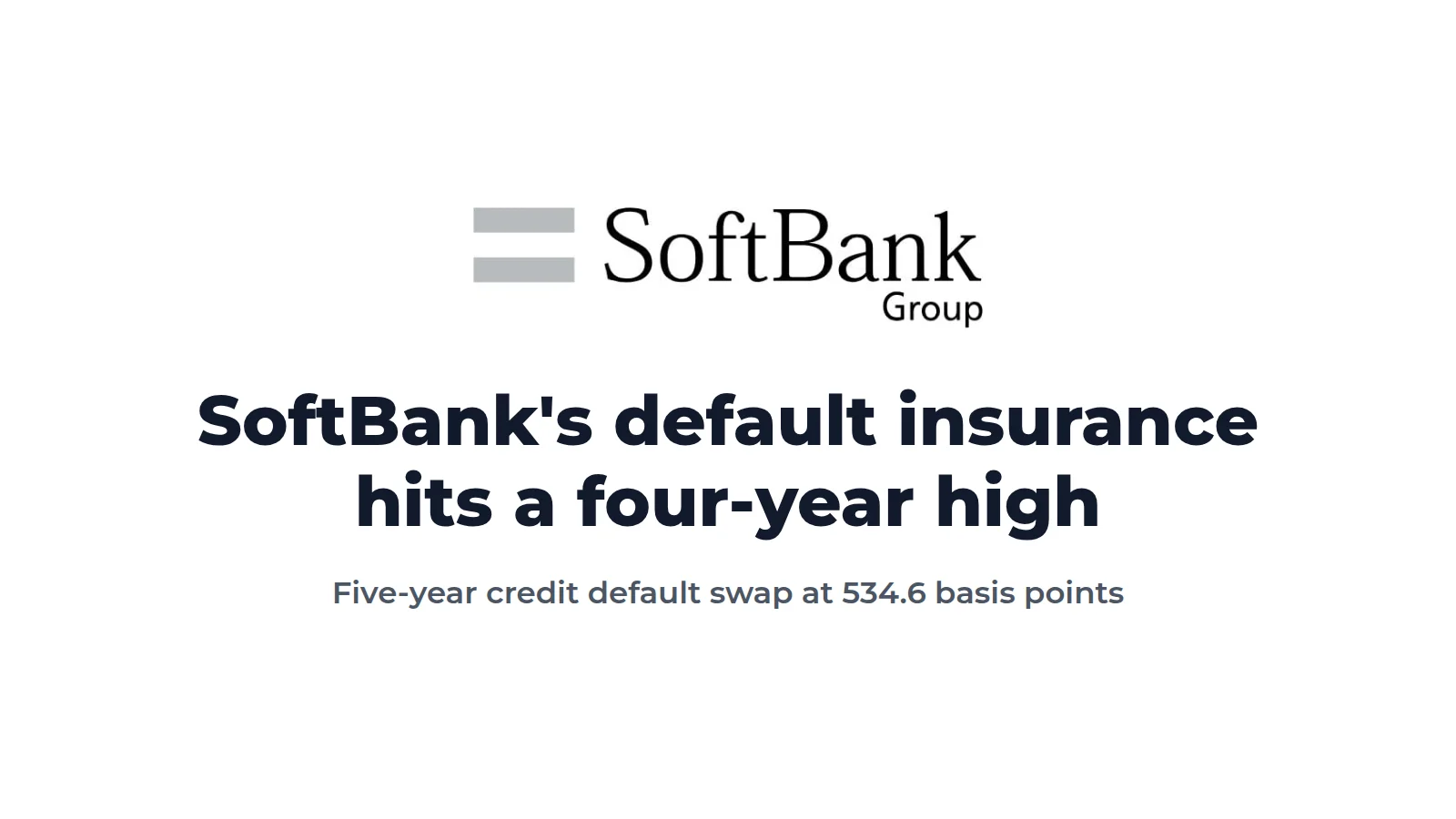
The cost of protection against a SoftBank Group (SFTBY) default rose to its highest level in four years on Nov. 26, as investors weighed the company's borrowing and its investments in AI.
SoftBank's five-year credit default swap spread widened more than 20 basis points to 534.6 basis points, Reuters reported. It was the second straight session in which the cost rose.
SoftBank shares moved the other way, closing up 7.3% at 2,894 yen in Tokyo. US markets are closed for Thanksgiving, so its US-traded shares haven't traded on the news yet.
What does a credit default swap measure?
A credit default swap, or CDS, is a contract that pays the buyer if a borrower defaults or experiences another specified credit event. Investors can use one to hedge bonds they own or to bet that a company's credit will worsen. They don't have to own the bonds to buy protection.
The cost is quoted as an annualized spread in basis points of the amount covered. One basis point is one-hundredth of a percentage point, so SoftBank's 534.6-basis-point spread is equivalent to 5.346% a year.
For illustration, that rate on $10 million of debt works out to about $534,600 a year. Actual payments can differ: standard contracts often include an upfront payment, and payments stop after a credit event. A wider spread means protection has become more expensive.
SoftBank's bond spread has widened, too
Earlier on Nov. 26, SoftBank's five-year CDS spread stood at 516 basis points at 6:30 a.m. in Tokyo, its highest since October 2022, Bloomberg reported.
The spread on SoftBank's 9.75% dollar bond has widened about 40% since the company sold it in September, reaching about 644 basis points, according to the same report. The note carries the highest coupon ever on one of SoftBank's dollar bonds.
The bond was part of an $11.1 billion, five-part sale priced on Sept. 24, with coupons from 7.125% to 9.75%, as our AI debt tracker shows. SoftBank used the proceeds for its latest OpenAI investment.
SoftBank has $64.6 billion invested in OpenAI
SoftBank has invested $64.6 billion in OpenAI, and investors are questioning when that money, and the rest of the AI buildout, will pay off, according to the Bloomberg report. OpenAI has ruled out an IPO this year.
"The broadening of the AI business isn't going to change, but monetization will take longer," said Masahito Sugawara, a senior strategist at Daiwa Securities, in the report.
SoftBank's finance costs for the July-to-September quarter were 461.9 billion yen ($2.9 billion), 2.6 times what they were a year earlier. The company raised about 9 trillion yen during the quarter. Its rising borrowing costs and large AI investments have drawn investor scrutiny.
S&P Global Ratings said this month that SoftBank's key credit measures were approaching the limits for its rating. S&P estimated SoftBank's loan-to-value ratio has risen above 30%, close to the 35% level at which it would consider a downgrade.
SpaceX's and CoreWeave's default insurance jumped on Nov. 5
Other AI borrowers' default insurance has also jumped this fall. On Nov. 5, SpaceX's five-year swaps hit a record 284.3 basis points, according to ICE Data Services. The same day, CoreWeave's spiked above 1,289 basis points, according to Deutsche Bank, as we reported when CoreWeave's bond yields topped 16%. Those are Nov. 5 readings, not current spreads, so they aren't a same-day comparison with SoftBank's.