Key points
- ULA's Vulcan rocket loses 40 Amazon Leo satellites
- Boeing and Lockheed each back up to $750 million of ULA credit
- The companies behind Vulcan's engines and boosters
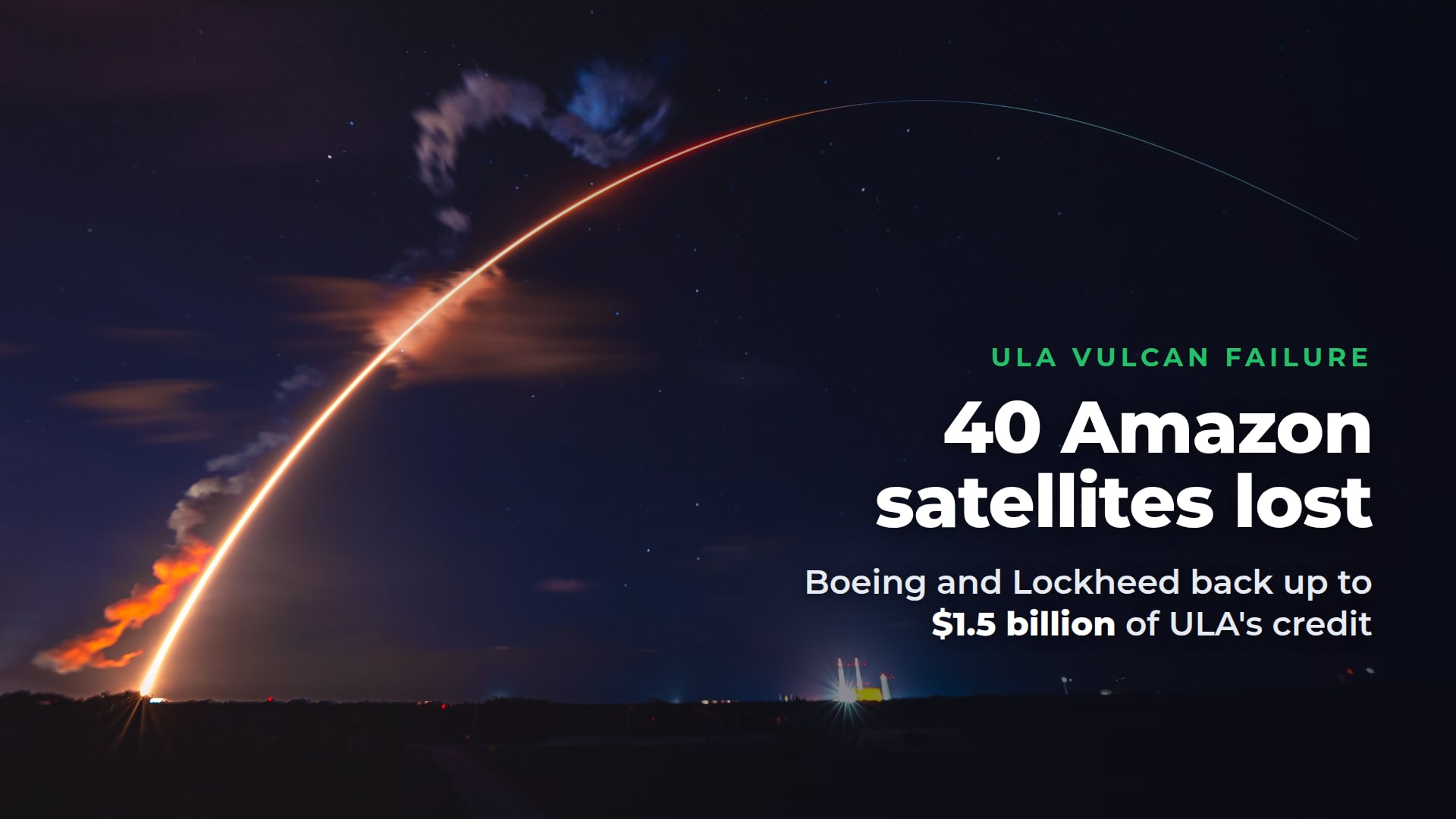
United Launch Alliance's Vulcan rocket failed to reach orbit on Sunday, Nov. 15, and the 40 Amazon (AMZN) Leo internet satellites aboard were lost. The failure comes after ULA's owners, Boeing (BA) and Lockheed Martin (LMT), warned that an earlier pause in Vulcan launches was hurting the joint venture. Each guarantees up to $750 million of ULA's credit facilities.
ULA said the rocket "suffered an anomaly 10 minutes into the flight and failed to deliver the Amazon mission to orbit." It said it didn't have data yet to explain what happened. It was ULA's first outright launch failure since the company was formed in 2006.
After the launch, I went back to the quarterly reports Boeing and Lockheed filed in October. Both said they expect to put more money into ULA.
What happened on Sunday's launch?
Vulcan lifted off at 12:40 p.m. ET from Space Launch Complex 41 at Cape Canaveral, Florida, after scrubs on Friday and Saturday. It was Vulcan's first flight since Feb. 12. On that Space Force mission, one of the rocket's solid boosters had a nozzle problem. The payload still reached its orbit, but the Space Force suspended Vulcan launches of national security missions while ULA investigated.
Sunday's rocket flew with six of the same boosters, made by Northrop Grumman (NOC). Early data showed they performed as expected and separated about a minute and a half into the flight, more than eight minutes before the anomaly ULA described. So the part of the rocket that gave trouble in February had finished its job well before anything went wrong. The first stage then appeared to fire longer than ULA's prelaunch timeline called for and to separate from the upper stage later than expected. A telemetry animation then showed the upper stage making unusual orientation adjustments early in its burn. ULA hasn't confirmed any of those observations or said which part of the rocket failed.
What have Boeing and Lockheed told investors about ULA?
ULA is a 50-50 joint venture, so each owner records half of its profit or loss. At the end of September, Boeing carried its stake at $572 million and Lockheed at $578 million.
Boeing's wording has changed each quarter. In April, Boeing's first-quarter 10-Q said only that the two owners "may provide financial support." The first guarantee came in May, according to Boeing's second-quarter 10-Q. The filing said the Vulcan pause was "negatively affecting ULA's financial condition and results of operations," and that Boeing and Lockheed had each agreed to guarantee $500 million of ULA credit facilities due July 30, 2027.
In the third quarter, ULA replaced those facilities, and Boeing and Lockheed each agreed to guarantee up to $750 million of new ones that mature Aug. 28, 2029, according to Boeing's third-quarter 10-Q, filed Oct. 27. That's up to $1.5 billion between them, more than the $1.15 billion at which the two companies carry their ULA stakes combined. The guarantees mean the owners could have to pay lenders if ULA defaults. Neither filing says how much ULA has borrowed, and the guarantees don't cap any other support the owners might provide.
The two filings describe the risk in slightly different words. Boeing wrote that it and Lockheed "expect to provide additional financial support in the fourth quarter of 2026 and could incur losses if ULA is unable to resume Vulcan launches consistent with ULA's assumptions." Lockheed's 10-Q, filed Oct. 22, said the owners could incur "impairment and operating losses if the Vulcan Centaur rocket does not perform consistent with ULA's assumptions." An impairment is a write-down of what the stake is worth on the books. Both left the size of the extra support open.
For scale, Lockheed had $6.0 billion of cash at the end of September. Both reports were filed in October, while Vulcan was still waiting to fly again. Their fourth-quarter reports will be the first written after a lost payload.
Who else built the rocket?
ULA buys Vulcan's engines and boosters from other companies. The first stage runs on two BE-4 engines from Blue Origin, the private rocket company founded by Amazon founder Jeff Bezos. The upper stage, Centaur V, uses two RL10 engines from Aerojet Rocketdyne, which is part of L3Harris (LHX). The solid boosters come from Northrop Grumman.
ULA hasn't identified which component failed, and nothing it's said so far ties Sunday's failure to the engines, the upper stage, or the boosters. The BE-4 engines on Sunday's rocket had been retrofitted with a Blue Origin design fix for a valve issue, according to ULA. Separately, Blue Origin traced the May 28 explosion of its own New Glenn rocket during a ground test to a main oxygen valve on one of its seven BE-4 engines. That New Glenn was being prepared for an Amazon Leo launch.
How much does this set Amazon Leo back?
Sunday's flight was the first of 38 Vulcan launches Amazon has bought, and it would have brought the number of Amazon Leo satellites launched to 436. Amazon's other bookings include 24 launches on Blue Origin's New Glenn, 24 on Europe's Ariane 6, and 13 on SpaceX's Falcon 9. Eight earlier Amazon Leo missions flew on ULA's older Atlas V.
"There is risk with any launch, and that's especially true for inaugural missions like LV-01," Amazon said. It added that it believes ULA will "learn from this mission and deliver on their long-term plans for Vulcan."
Under a June 5 order, the FCC gave Amazon Leo until July 30, 2029 to deploy all 3,232 satellites in its first-generation network. If it misses that date, it'll be limited to the satellites operating then. Amazon's also asked the FCC to approve a separate 5,105-satellite network that would connect straight to phones.
What happens next?
ULA said it'll work with Amazon and "other appropriate organizations" to find the cause and return to flight as quickly as possible. U.S. markets were closed Sunday, so Monday, Nov. 16, is the first trading session since the failure for Boeing, Lockheed, Amazon, Northrop, and L3Harris.
Boeing and Lockheed could disclose new ULA support or losses in any filing, including their 2026 annual reports. Lockheed's filings land on the LMT stock page and Boeing's on the BA stock page.