Key points
- A pension fund sues Intel, Tan, and Zinsner
- What Intel's CFO said about PC chips in July
- Lip-Bu Tan bought into the stock sale the suit cites
A Michigan pension fund has sued Intel (INTC), alleging that the chipmaker played down the effect of a PC slowdown before its shares fell 28.6% on Oct. 30. The proposed class action also names CEO Lip-Bu Tan and CFO David Zinsner.
The complaint, filed Nov. 13 in federal court in San Jose, points to Intel's $23 billion stock offering in August as a motive for the alleged omissions. It doesn't mention that Tan bought about $10 million of those shares himself at the $95 offering price, according to his Form 4 filings.
The plaintiff, the City of Southfield Fire and Police Retirement System, seeks unspecified damages on behalf of investors who bought Intel shares from July 23 through Oct. 29. Reuters reported the suit on Nov. 15 and said Intel didn't immediately respond to requests for comment. No court has ruled on the allegations.
What does the lawsuit say Intel got wrong?
I read all 24 pages of the complaint. It challenges statements Intel made in its July 23 earnings report and call, and in its quarterly filing the next day. Intel reported $16.1 billion in second-quarter revenue, including $8.9 billion from its PC chip unit, the Client Computing and Physical AI Group. That unit's revenue was up 13% from a year earlier.
Zinsner did warn about the PC market. In his prepared remarks, he said Intel expected PC consumption to be "down low double-digits percent for all of 2026, impacted by rising memory prices and constraints." The complaint acknowledges that warning. Its argument centers on Intel's own PC chip sales, which Zinsner expected to hold up better than the market in the third quarter.
An analyst later asked whether the PC business was holding up only because Intel had raised prices. Zinsner said the market was "struggling with the memory dynamics," but that PC makers had kept their inventories of Intel processors tight and would likely build them up in the third quarter. "Overall, CCPG is likely to be up a bit," he said, referring to Intel's PC chip unit. He expected Intel's own business to soften in the fourth quarter.
Intel's quarterly report the next day said PC chip demand had "exceeded our available product supply" in the second quarter. It also said Intel expected supply constraints "to ease over the second half of 2026." The complaint quotes both statements.
The pension fund says those statements omitted four problems: the PC slowdown was already hurting third-quarter results more than Intel had disclosed; PC makers and distributors were holding a "massive glut of unwanted PC inventory"; data center gains couldn't offset the weakness; and a shortage of substrates, the bases chips are packaged on, limited Intel's ability to shift production to data center chips.
The complaint doesn't cite former employees or internal documents. It relies on Intel's filings and earnings calls, along with analyst notes and news coverage.
What happened to Intel's PC business in the third quarter?
On Oct. 29, Intel reported PC chip unit revenue of $8.1 billion, down 9% from the second quarter, or about $800 million. Intel's third-quarter 10-Q said notebook and desktop chip volume fell 14% from a year earlier "due to lower demand and a competitive market environment."
Intel's executives also said when it got worse. Zinsner said Intel had previously noted that memory shortages could pressure PC demand in the second half, and "that pressure intensified during Q3, particularly late in the quarter." Tan said that "in recent weeks, our customers began signaling a PC slowdown based on the memory prices and availability." Both quotes are from the Oct. 29 call transcript.
Intel guided to fourth-quarter revenue of $15 billion to $16 billion, below the $17.07 billion analysts expected, as we reported that day. Zinsner described an inventory correction at PC makers. "We felt a little bit of it in the third quarter," he said. "We're going to feel a lot of it in the fourth quarter."
Intel closed at $65.76 on Oct. 30, down from $92.07 on Oct. 29. The complaint calls it the stock's biggest one-day drop in more than 50 years.
Why is the $23 billion stock sale in the complaint?
A securities fraud suit has to show more than a forecast that turned out wrong. The plaintiffs have to plead scienter, which means the executives either knew their statements were misleading or were reckless about it. A stock sale can be cited as a motive, but courts have generally held that a company's wish to raise money doesn't establish scienter by itself. A judge weighs the allegations together.
The final prospectus offered 210,526,315 shares at $95, about $20 billion. That deal closed Aug. 12. The underwriters also bought about 32 million more shares, and the third-quarter 10-Q says Intel issued about 242 million shares in all for $23.0 billion in gross proceeds. The complaint says the sale "occurred halfway through Intel's disastrous third fiscal quarter."
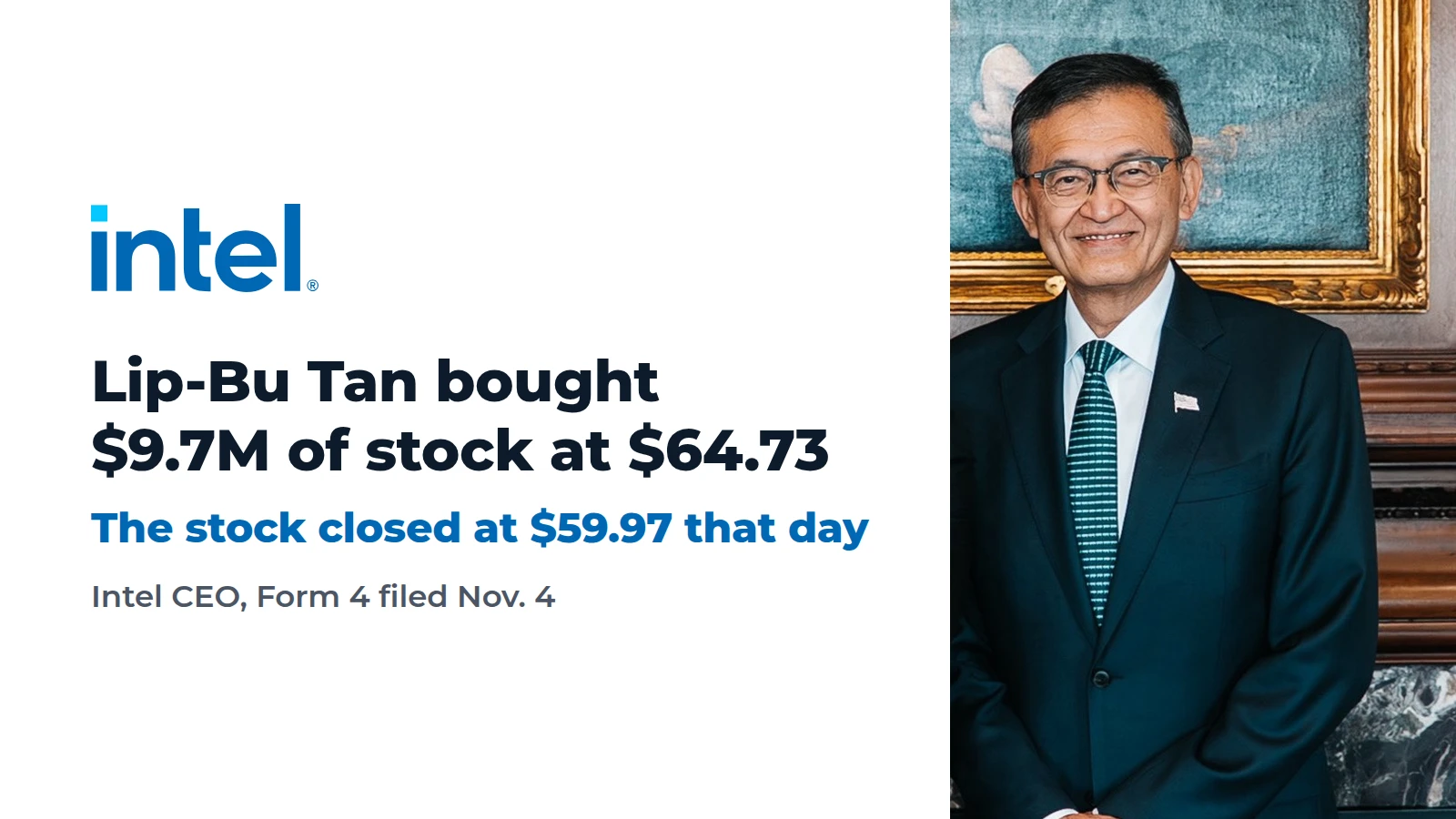
The same prospectus has a line the complaint leaves out. Tan and one of his family members "agreed to purchase $12 million of the shares being offered in this offering at the public offering price." His trust bought 105,263 shares at $95 on Aug. 11, about $10 million, according to his Form 4. He bought again after the drop, 150,000 shares at an average of $64.73 on Nov. 2, which shows up on our insider-buying tracker. The complaint mentions neither purchase.
Tan's purchase complicates the motive argument, but it doesn't settle it. The $23 billion went to Intel, and Tan bought for his own account. His purchase doesn't resolve what Intel or its executives knew when they made the statements.
The final prospectus never uses the word PC. It sends buyers to Intel's annual report and its two 2026 quarterly reports for the risks, including the July 10-Q quoted above. Its list of risks in the forward-looking statements section does mention "current industry-wide substrate and memory shortages."
Where are Intel shares now?
Intel closed at $59.66 on Friday, Nov. 13, the day the suit was filed. That's 37.2% below the $95 offering price. At that close, all of the roughly 242 million offering shares together would have been worth about $14.4 billion, against the $23.0 billion they sold for. That isn't a measure of what buyers lost, since some of those shares have been sold since August. The complaint says the stock later fell below $52. That was an intraday low of $51.51 on Nov. 5, and Intel closed at $52.25 that day.
The shares are still up 62% this year, Reuters reported, and they've fallen from an intraday peak of $142.35 on June 30. Intel lost 45.3% in October alone, and about half of that came before the PC warning.
What happens next in the Intel case?
Other investors who bought during those three months have until Jan. 12, 2027 to ask the court to make them lead plaintiff, according to Robbins Geller. The court picks one, and that plaintiff usually files a longer, amended complaint. If Intel asks the court to dismiss it, a judge decides whether the complaint has laid out enough to go forward.
Intel's account, from its own executives on Oct. 29, is that the PC slump intensified late in a quarter that ended Sept. 26. The stock sale closed Aug. 12, about halfway through it. The complaint says Intel "generally has advanced awareness" of PC demand through its customers' inventories. It doesn't identify what Intel knew in July or early August, or how it knew it.
New Intel filings show up on the INTC stock page.