Key points
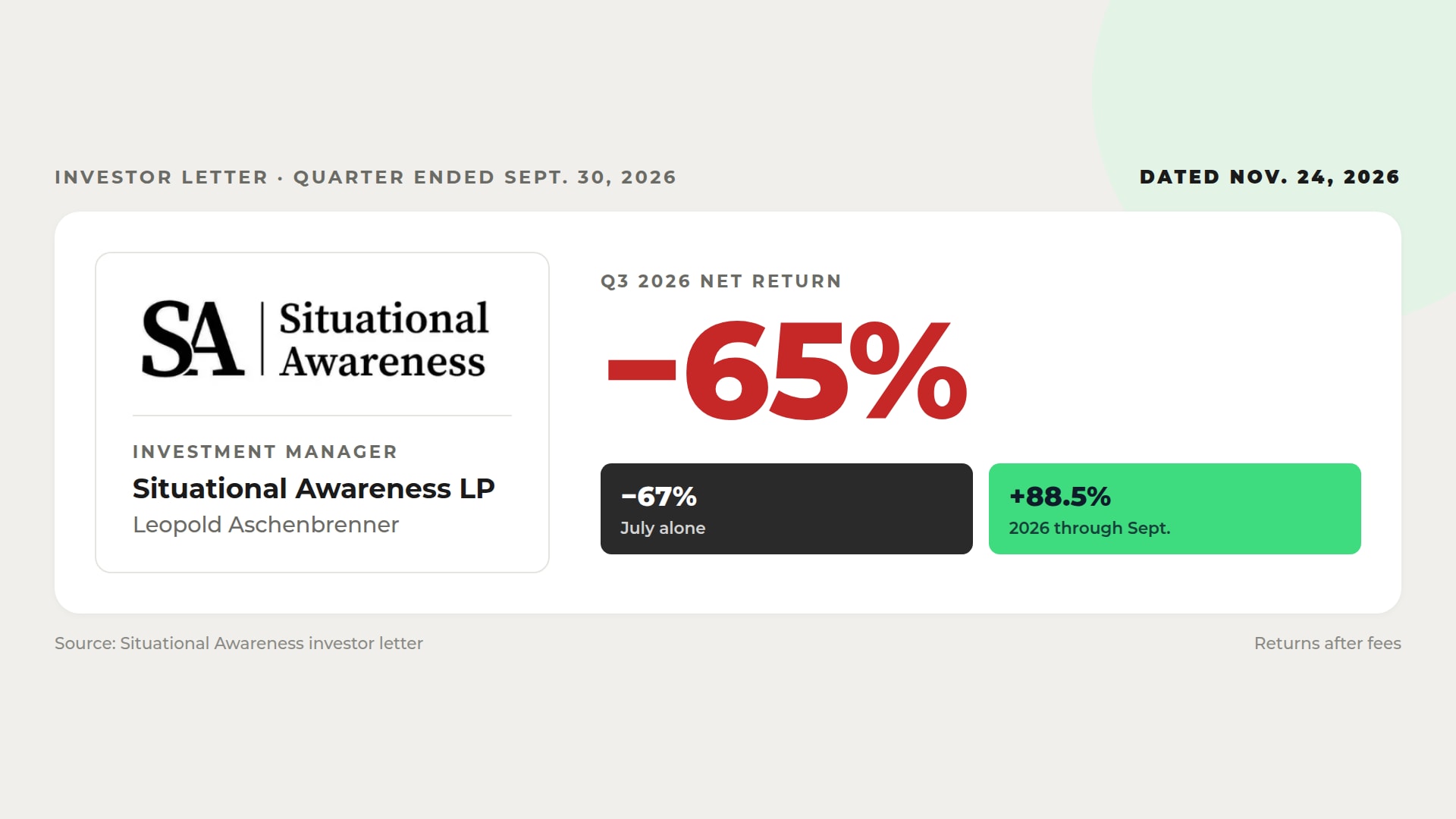
- Situational Awareness lost 65% after fees in the third quarter
- Aschenbrenner’s letter bets on Anthropic and $1 trillion in AI lab revenue
- How Situational Awareness rebuilt its portfolio after July
Leopold Aschenbrenner’s hedge fund, Situational Awareness LP, lost 65% after fees in the third quarter, but remained up 88.5% for the year through September, according to an investor letter cited by The Wall Street Journal.
The fund’s gains before July explain how both figures can be true. It was up 439% after fees in the first half, according to an earlier letter reported by Reuters. A 65% loss from roughly that level would leave a gain of about 89% for the year.
In the Nov. 24 letter, Aschenbrenner predicts that Anthropic (ANT) will rise, Business Insider reported. The letter runs about 165 pages and was later posted online. The fund details below come from a review by the tech news site Sulat, which checked the letter’s figures against the sources it cites.
How did the fund lose 65%?
Situational Awareness went into July about 1.6 times long and 1 times short, according to the letter. Sulat's review doesn't specify what those multiples are measured against. Many AI stocks fell more than 50% that month, and some of the fund's largest longs fell more than 60%.
The hedges didn't hold up. Micron (MU), which the fund shorted against its SK Hynix position, fell about 30%, while the Hynix position fell 55% to 65%. A separate short book, betting that Claude's coding tools would hurt software, IT outsourcing, and consulting companies, rallied 30% to 50% against the fund.
On July 29 and 30, the fund covered all of its shorts and sold roughly half of its public long exposure in a block trade. It finished July down 67% after fees. Reuters reported at the time that Citadel bought most of the fund's public stock holdings.
What does the letter predict for 2027?
The letter forecasts a median of three years of AI progress in 2027, within a modeled range of two to six years. It argues that investors are pricing in 0.3 to 0.6 times a normal year of progress.
The letter puts buy-side expectations for Anthropic's run-rate revenue at $120 billion to $200 billion by the end of 2027. The fund's own forecast is for combined AI lab revenue above $1 trillion by then.
Anthropic was by far the fund's largest private investment, according to the letter. Aschenbrenner's wife is chief of staff to Anthropic CEO Dario Amodei, Business Insider reported.
The letter calls Anthropic highly profitable, and Sulat's review doesn't say which measure the letter uses. Anthropic's filing shows third-quarter adjusted operating income of $2.5 billion, but a $567 million operating loss and a $23.3 billion net loss under standard accounting. Most of the net loss came from non-cash changes in the value of financing instruments.
What does the fund's 13F show?
Situational Awareness reported $1.58 billion in 13F holdings as of Sept. 30, down from $20.24 billion at the end of June. Much of the September figure came from call-option positions tied to Bloom Energy (BE), Nebius (NBIS), SanDisk (SNDK), and the Roundhill Memory ETF.
Those totals are not the fund's assets under management, and the drop from $20.24 billion to $1.58 billion isn't a measure of the fund's investment loss. For options, the filing reports the value of the underlying shares rather than what the fund paid for the contracts. A 13F also omits short positions and private investments, including the fund's Anthropic stake before the IPO. Our Situational Awareness tracker has the full filing.
How has the fund changed since July?
As of the letter's Nov. 24 date, the fund's book was fully paid for, with no financing leverage, Aschenbrenner wrote. That describes the book on that date and doesn't rule out options or leverage later. In September, the fund was reported to be using customized options through a new broker. Staff has grown from three people to nearly 30, and after Anthropic's listing, the portfolio is back to its usual mix of about 70% public and 30% private investments.