Key points
- Google's AI chips are in orbit for the first time
- Planet has made contact with the satellite
- The chips will run in 15-minute bursts to manage heat
Google (GOOGL) has sent its custom AI chips into orbit for the first time. A satellite built by Planet Labs (PL) will test whether Google's Tensor Processing Units, or TPUs, can operate in space.
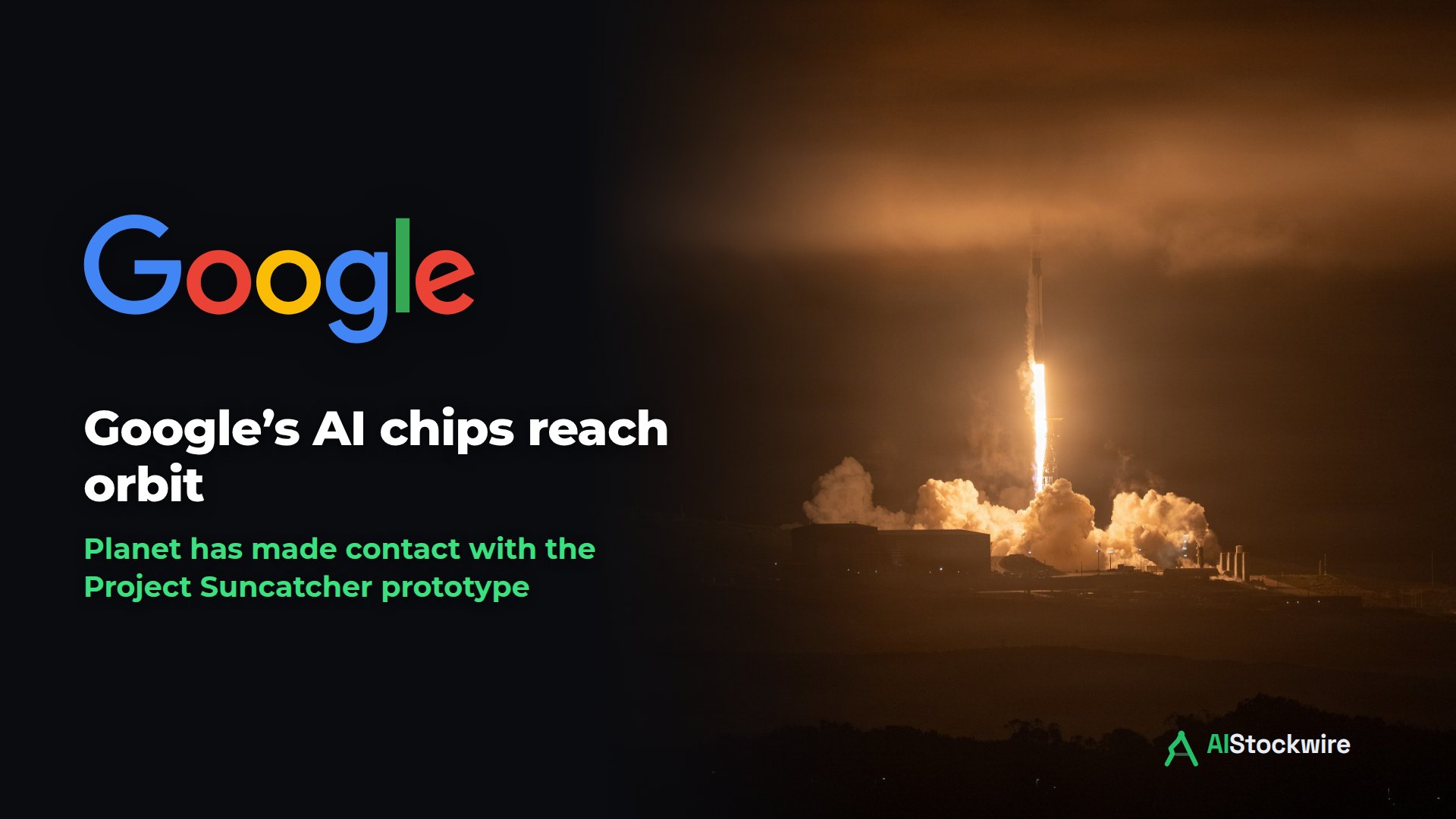
The Project Suncatcher prototype launched Thursday aboard SpaceX's (SPCX) Transporter-18 rideshare mission from Vandenberg Space Force Base in California. Planet said it has made contact with the satellite and begun checking its systems before Google starts the chip tests.
What is the satellite carrying?
The refrigerator-sized satellite carries four TPUs, the same kind of chip Google uses in its data centers on Earth, NPR reported. The chips will run a version of Google's Gemma AI model to answer simple queries, 15 minutes at a time, because of heat limits.
Travis Beals, the Google senior director who leads Project Suncatcher, called it "a very minimal test" to make sure the chips can run in space. Planet will get the satellite running first, and then Google will start testing the TPUs, he told NPR. The goal is for the mission to operate for a year.
We covered the plan when Google announced the launch last week. It isn't an orbital data center. Google says the mission is meant to show whether its chips can survive launch and run in orbit.
What challenges does Google need to solve?
Radiation is the first test. Google ran its Trillium TPUs through a proton beam at UC Davis before launch. The chips' high-bandwidth memory only began showing irregularities at nearly three times the radiation dose Google expects over a five-year mission, the company said in a research post in November 2025.
Heat is the second. There's no air in space, so fans can't cool the chips. Google is using heat pipes and radiators to carry heat away. Beals told NPR the radiators are among the heaviest parts of the satellite, and heavier objects cost more to launch.
The third is networking. Google wants future satellites to carry dozens of TPUs each and fly in tight clusters linked by lasers. A bench-scale version of that link has reached 800 gigabits per second in each direction, according to Google. A two-satellite test of the lasers is planned for 2027.
Why put AI chips in space?
Power. In the right orbit, a solar panel can be up to eight times more productive than on Earth and can generate electricity almost continuously, according to Google. The satellite sits in a sun-synchronous orbit where its panels are almost never in shade.
Cost is the open question. Google's analysis suggests launch prices could fall below $200 per kilogram by the mid-2030s. At that price, the cost of launching and running a data center in space could become roughly comparable to the energy cost of a similar data center on Earth, Google said.
"I don't see this being something where it's cheaper to do this in the next five years. I think it will take longer than that," Beals told NPR.
Google isn't alone. SpaceX and Nvidia (NVDA) aim to launch AI data centers into orbit in 2027.
Alphabet shares closed Thursday at $338.24, down 1.7%. Planet closed at $16.14, down 1.5%.