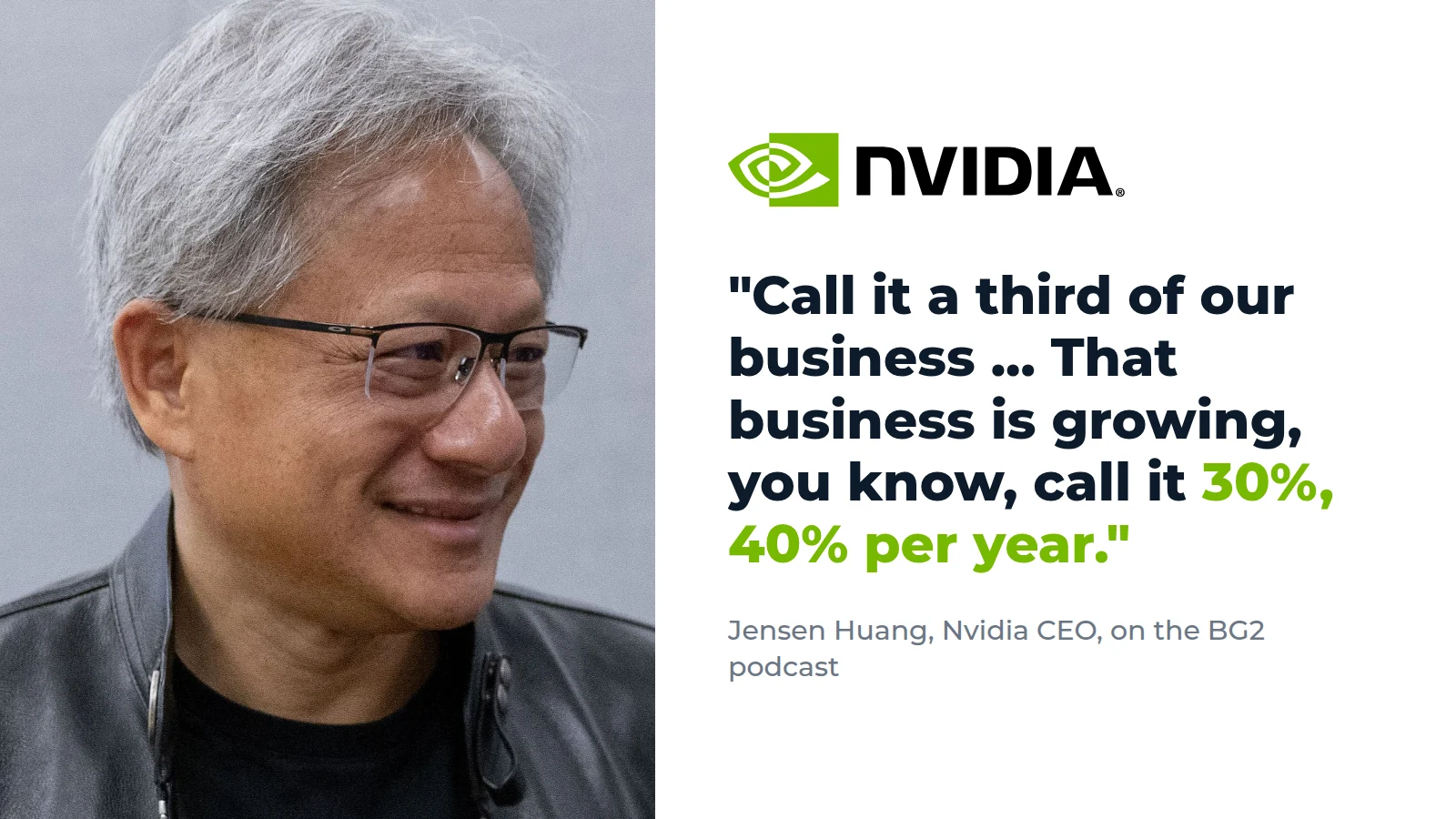
Nvidia (NVDA) CEO Jensen Huang says a third of its business grows 30% to 40% a year without AI labs
Huang put frontier labs at about a quarter of Nvidia's compute, while Nvidia's own filings show its customer mix shifting.
Chip stocks fell 8 straight days, longest since 2008. South Korea's finance minister sees growth through 2027
The Philadelphia chip index is nearly 24% below its June record. Seoul's top economic official points to a supply gap that hasn't closed.
Nasdaq posts worst week since June as memory stocks tumble. SpaceX, Tesla, and Meta report next week.
Micron lost 14.6% in a week that brought a Chinese memory launch, a hot inflation report, and two Elon Musk posts about RAM.
Bank of America says Nvidia (NVDA), Broadcom (AVGO), and Micron (MU) already trade like post-crash Cisco
Chip stocks are down about 10% this week. Bank of America's chip analyst says the valuation reset already happened, while Wells Fargo's strategist leans toward software.

Hot CPI pushed October Fed hike odds above 50%. They fell to 33%, but stocks kept sliding.
October rate-hike odds topped 50% after hot CPI, then faded to 32.7% by late afternoon. For the AI buildout, what Fed Chair Kevin Warsh signals may matter as much as the decision.
Broadcom (AVGO) CEO says capital may be AI's biggest constraint. Intel's (INTC) CEO says the returns have to show up.
Hock Tan and Lip-Bu Tan said in Singapore that financing may become the AI buildout's biggest constraint, even as demand still outruns supply.
WSJ columnist says a price crash could end the AI boom. I think cheaper AI could also prolong it
AI prices have been falling fast. The real question is who eats the decline.
Broadcom (AVGO) or Micron (MU)? What needs to go right over the next three years
One sells custom chips to a handful of giant customers. The other sells memory at prices set by supply. Here is how the two AI chip stocks compare.
Broadcom (AVGO) is arranging more than $50 billion to finance OpenAI's chips
Apollo and Blackstone, already Broadcom's financing partners, are among the lenders approached. Oracle and SpaceX are raising chip debt too.
Broadcom (AVGO) would help finance Anthropic's computing bill. Who bears the risk?
The chip designer is also offering to help pay for computing built on its chips. Michael Burry's 1960s leasing warning was about Nvidia, but I think it fits here too.
Anthropic's IPO could come before Thanksgiving at about $2 trillion as Broadcom (AVGO) lines up $60 billion
Anthropic has invited big investors to an Oct. 14 investor day ahead of an IPO that could come as soon as mid-November, Bloomberg reported. Broadcom's double role as chip supplier and lender is a conflict Anthropic's prospectus flags.
Nvidia (NVDA) wants its chips to back $500 billion in AI loans. Lenders want bigger guarantees.
Banks and credit investors want stronger guarantees before backing Nvidia's $500 billion chip-backed financing plan, Reuters reported. The sticking point is how many years an AI chip keeps earning money.

Broadcom (AVGO) agrees to lend Anthropic up to $42 billion to help pay for computing built on its chips
Anthropic's IPO filing shows Broadcom acting as both its chip supplier and its lender, Reuters reported. The filing warns that dual role could affect Anthropic's access to computing power.
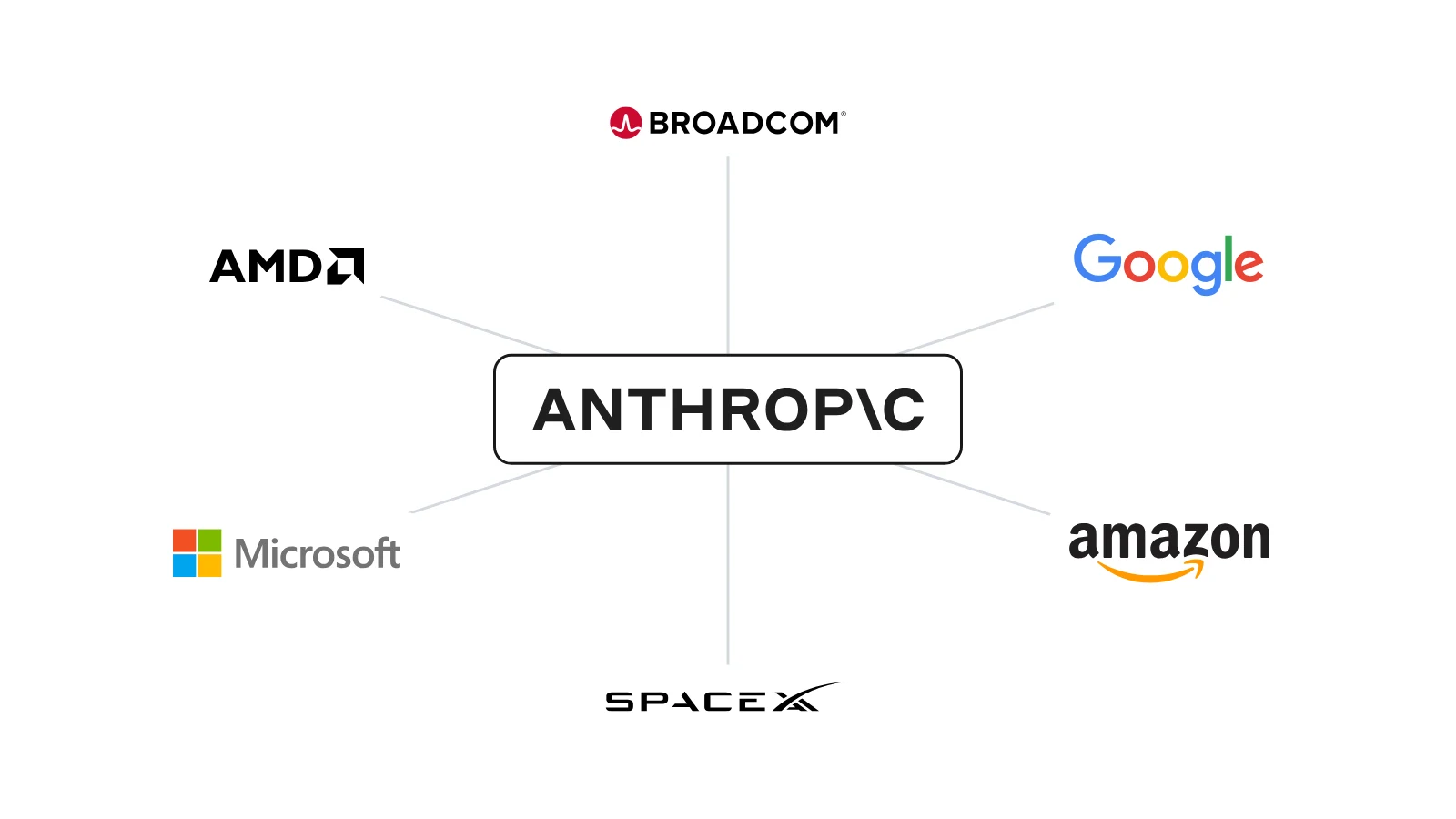
Anthropic's $518 billion AI buildout: about 80% is reportedly locked in, even if the capacity goes unused
Anthropic must pay Google the difference if its compute spending falls short, Reuters reported, citing the IPO prospectus. Who else is locked in, and which deals can Anthropic cancel?
Huawei unveils an 11-chip AI portfolio and says Ascend demand already tops supply (NVDA, AMD, INTC)
Huawei laid out an 11-chip AI infrastructure portfolio at Huawei Connect on September 17, pulled its next Ascend accelerator forward to early 2027, and said domestic demand is already outstripping supply. It is a direct challenge to Nvidia (NVDA), AMD and Intel (INTC).
Anthropic's compute contracts could reach $517 billion. Most are not public.
The Information estimates Anthropic cloud, chip and data center agreements at as much as $517 billion over the coming decade, covering at least 14.8 gigawatts agreed since October. Anthropic has confirmed four of the deals and none of the aggregate figures.
Nvidia (NVDA) licensed Groq and hired its founder. The DOJ is asking if that sidestepped antitrust review.
The Justice Department is investigating whether Nvidia structured its deal for Groq's inference chip technology to avoid antitrust review, the New York Times reported Wednesday. Nvidia licensed the technology and hired Groq's founder rather than buying the company.
Alphabet (GOOGL) backs chip startup Celero at a $3 billion value. It is building chips to link AI data centers over fiber.
Alphabet's growth fund CapitalG is backing Celero Communications at a valuation above $3 billion, Bloomberg reported Tuesday. The two-year-old startup is developing chips to move AI data over fiber between racks and nearby data centers, and its founders developed coherent chips at Inphi and Marvell.
Sivers Semiconductors (SIVEF) is spending $30 million to reach 100 million lasers a year. It still hasn't disclosed a customer order.
Sivers is spending $30 million to reach 100 million lasers a year by late 2027. It has still not disclosed a customer purchase order for any of that capacity.
Broadcom (AVGO) targets $230 billion in AI revenue by 2028, and the call turned a 4.6% after-hours drop into a gain
Broadcom reported $16.7 billion of AI semiconductor revenue for its fiscal third quarter and then told investors to expect about $115 billion next fiscal year and about $230 billion the year after, with supply already secured for both. Shares fell as much as 4.6% after hours on a fourth-quarter revenue guide just under consensus, then turned positive during the call.
Nvidia (NVDA) cut Rubin Ultra's memory in half because HBM had become 40% of a rack's cost, SemiAnalysis says
SemiAnalysis says memory had reached 41% of a Rubin Ultra rack's capital cost after this year's HBM and DRAM price hikes. Halving the HBM per GPU takes it to 28%, with the savings moving to scale-up networking. The firm calls it a supply-crunch symptom, not weak demand.
Nvidia's (NVDA) $3.5 billion MediaTek deal turns the chips built to replace its GPUs into an ecosystem play
Nvidia is buying $3.5 billion of MediaTek convertible bonds as MediaTek joins NVLink Fusion to build custom XPUs. The bigger reveal is NVHBM, Nvidia's custom memory claiming 30% more bandwidth than HBM4E, with Amazon's Trainium4 first in line.

Marvell (MRVL) fell 10.3% on margins. Now Dell (DELL), Credo (CRDO) and Broadcom (AVGO) report into the same question
Marvell fell 10.3% Friday after guiding gross margin lower on a greater custom mix. Ten of the names we track report between September 1 and 3, and Broadcom, Credo and Ciena all sell into the same build.

Broadcom (AVGO) told Wall Street to expect $16 billion in AI chip revenue. On September 2, it has to deliver.
Broadcom reports fiscal Q3 on September 2 with AI revenue guided to $16 billion, more than triple a year ago. The stock sits 25% below its June high, and options price a move of just over 8%.