Key points
- AI-referred shoppers were 74% more likely to buy on Thanksgiving
- AI traffic to retail sites doubled on Black Friday
- Amazon asks AI bots to stay off its site
- What Cyber Monday can reveal about AI shopping
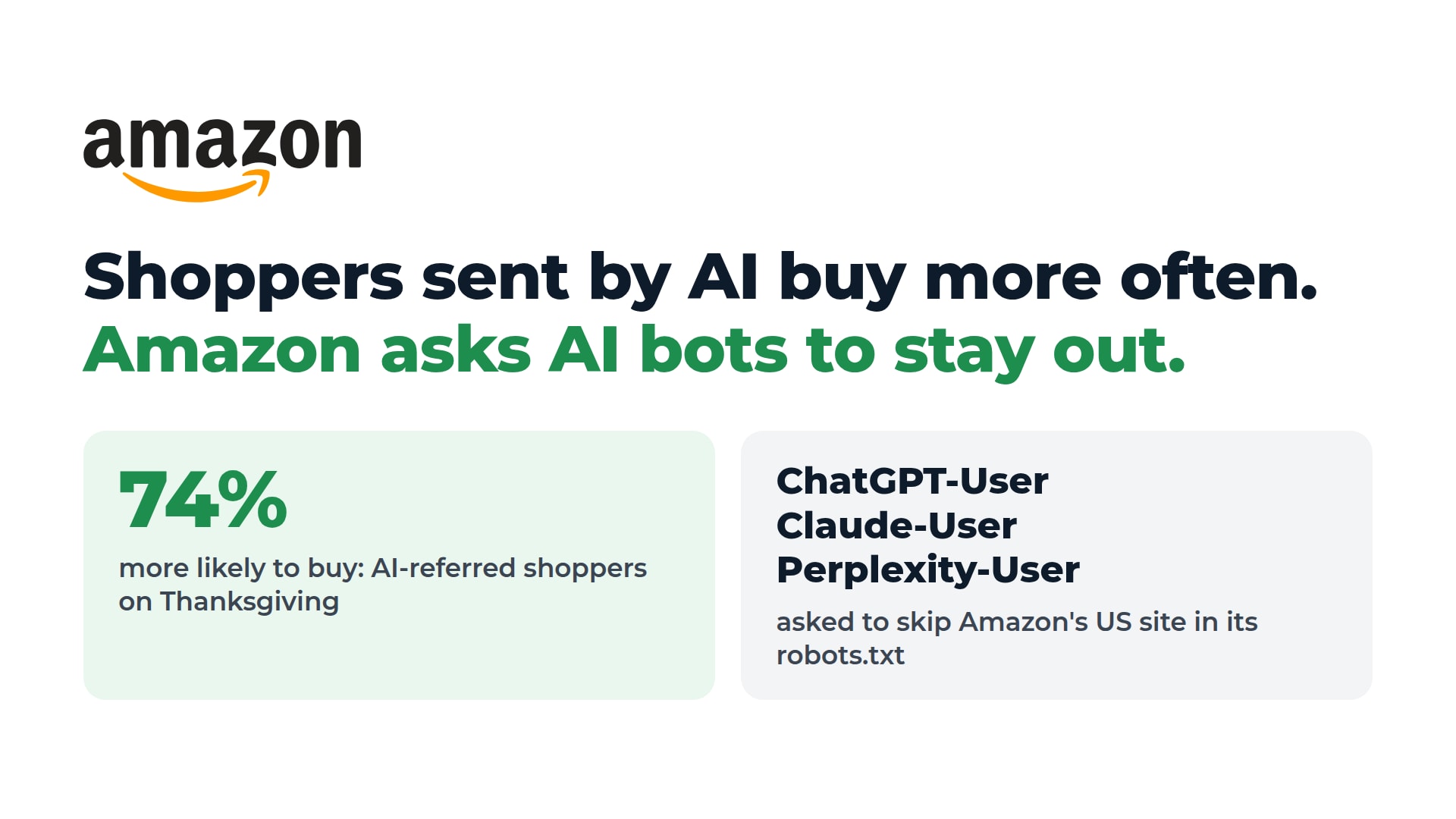
Shoppers who clicked from AI services to US retail sites on Thanksgiving were 74% more likely to buy than visitors from other sources, Adobe’s global retail and consumer lead, Marta Frattini, said in a LinkedIn post. The next day, traffic from AI sources doubled from a year earlier.
Meanwhile, Amazon (AMZN), the largest US online retailer, is asking AI companies’ bots to stay off its site. Adobe’s data doesn’t explain Amazon’s choices. But I think both stories point to the same question: who gets the customer when AI helps people shop?
What Adobe’s AI shopping numbers measure
Adobe counts a visit as AI-referred when someone clicks from an AI service to a retailer. It compares those visits with traffic from other sources, including email, paid search, and social media. The measure doesn’t show whether an agent browsed a store, filled a cart, or paid on someone’s behalf.
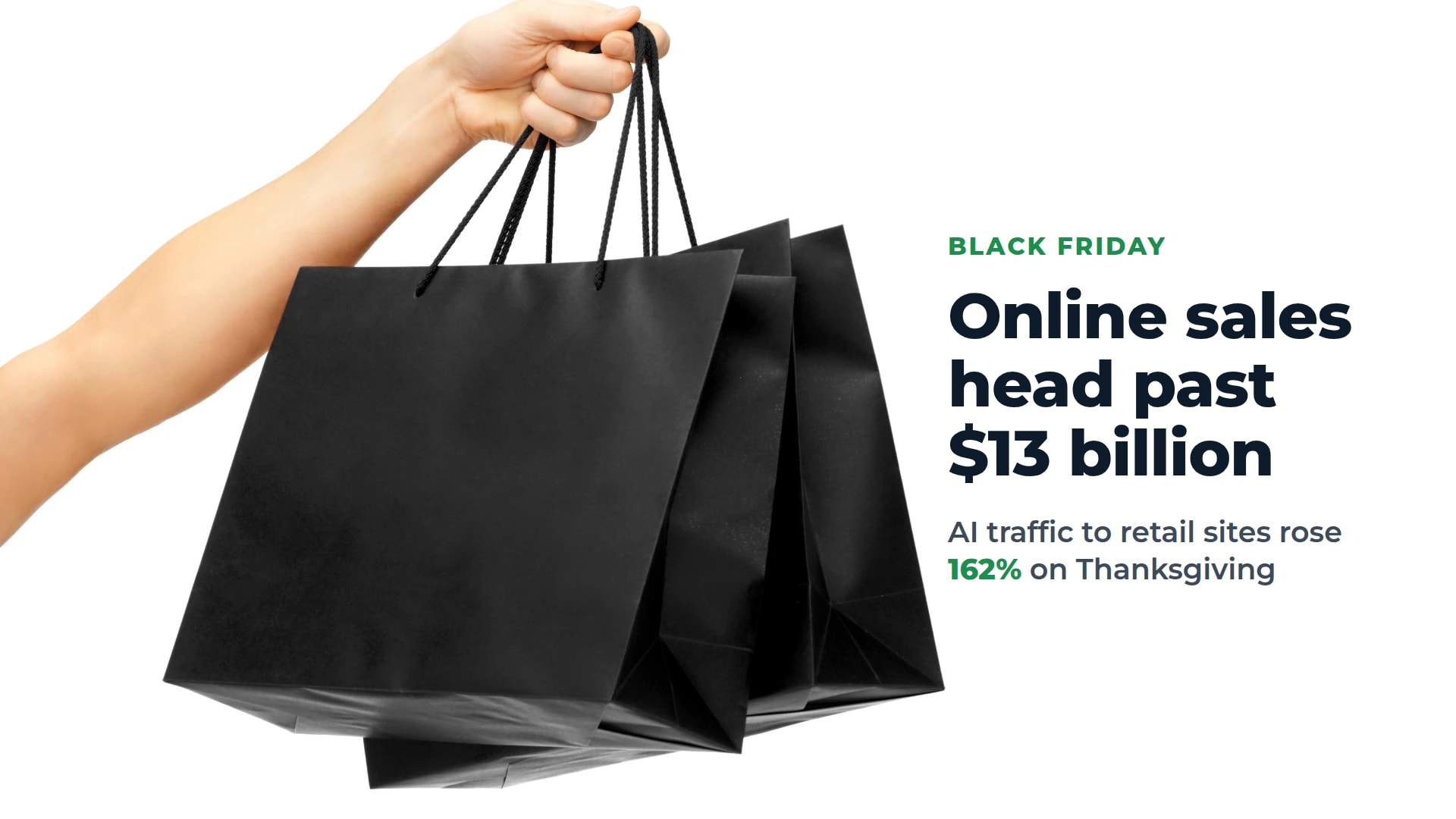
On Thanksgiving, AI-referred traffic rose 162% from a year earlier, slightly above Adobe’s forecast of 159%. US shoppers spent a record $7.1 billion online that day, above the company’s $6.9 billion forecast. Mobile devices accounted for a record 63.2% of spending.
The 74% conversion premium was below the figure Adobe recorded in September, when AI-referred visits were 90% more likely to result in a purchase than other visits. September’s figure covers a full month; Thanksgiving’s covers one day. Adobe hasn’t explained the difference. In August 2025, AI-referred traffic converted 9% worse than other traffic.
On Black Friday, AI-referred visits converted 68% better than non-AI visits, according to Adobe Digital Insights figures shared in a LinkedIn post.
What Amazon's robots.txt file asks
Amazon's robots.txt file is a public list that asks automated visitors to stay out of certain pages. It works only if each bot chooses to follow it. As of Nov. 27, it asks OpenAI's ChatGPT-User and OAI-SearchBot to skip every page of Amazon's US site. It makes the same request of Anthropic's Claude-User and Claude-SearchBot and of Perplexity's Perplexity-User and PerplexityBot. Some AI companies say their user bots may not follow robots.txt, as we reported on Amazon's file.
Those are two kinds of bots. A user bot visits a page when someone asks the AI for something. A search bot helps build the index that AI answers can draw links from. Amazon's file covers both. That doesn't mean Amazon pages can't show up in AI answers, since AI services can also draw on other sources.
Amazon has gone further with specific agents. It blocked Meta's Muse agent from shopping on its platform in September, saying it never agreed to participate. It stopped Elon Musk's Grok bot from placing orders in October. Amazon also said Muse doesn't identify itself when it browses and appears to capture and store customer credentials, according to GeekWire. Meta has said Muse has no visibility into people's passwords or payment methods.
Other stores drew the line in different places. eBay, United Airlines, and Kohl's limit what agents can do or block them outright. Coach and Gap let AI bots browse but not check out, according to an August audit by Billions Network. Walmart (WMT) and Sephora have opened their sites to agents.
What Amazon may be protecting
Amazon CEO Andy Jassy has said the company expects "over time, to partner with third-party agents," but that any partnership will need the right "value exchange" between agents and retailers. That leaves room for a deal.
My guess is that advertising is part of what's being negotiated, though Amazon hasn't said so. An agent that compares prices and checks out for you doesn't need to scroll Amazon's search results, sponsored listings, or recommendation rows, and those pages carry Amazon's ads. Its advertising revenue rose 11% to $19.6 billion in the third quarter.
ChatGPT Wallet makes blocking a business choice
OpenAI launched ChatGPT Wallet on Nov. 13. It lets OpenAI's "dots" agents pay for purchases after the user approves each one. OpenAI built it with Visa (V), Mastercard (MA), and American Express (AXP), and it isn't taking a cut of those purchases to start. Once an agent can pay with the customer's approval, how much access to give it is a decision each store makes about its own business.
Purchases made by agents themselves are a separate measure from Adobe's referrals, and they're still small. Agent purchases made up 0.4% of global e-commerce transactions and 0.2% of their value, according to Bain & Co. research published this month. Shopify (SHOP) President Harley Finkelstein expects that to change. "I think last year we saw AI influence more in discovery," he told CNBC. "I think now we're going to see more of that conversion."
What Cyber Monday can show
Black Friday online sales hit a record $13.1 billion, up 11.1% from a year earlier, according to Adobe's holiday report. That exceeded Adobe's September forecast of $12.9 billion and fell within the updated range it gave on Nov. 27. Adobe expects $15.1 billion in US online spending on Cyber Monday, Nov. 30, up 6.2%. In October, Adobe repeated its forecast that AI traffic to retail sites would rise 95% on Black Friday and 88% on Cyber Monday. Thanksgiving and Black Friday both came in above forecast, at 162% and 100%. Adobe's data covers US retail sites as a group, so a Cyber Monday result above or below 88% will show how fast AI referrals are growing overall. It won't show how Amazon is doing or why its policies changed.
Amazon's robots.txt rules cited here were read from its US site on Nov. 27, 2026.